Live at the Fair

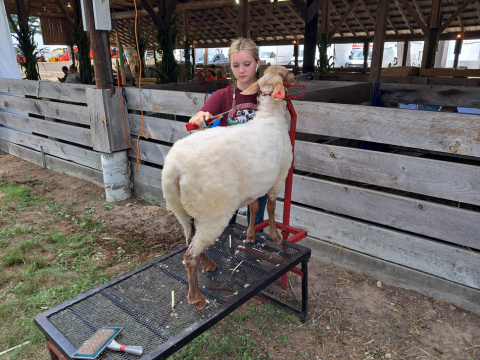
Kendall and Rebecca visit the Hopkinton Fair to highlight how 4-H helps young people build confidence, practical skills, and community. Featuring interviews with Sarah Gardner, Dakota Glover, Lilly Suponski and Wade Weber, the episode explores hands-on learning, livestock projects, and the lasting impact 4-H has on youth and their families.
Show notes:
New Hampshire 4-H: https://extension.unh.edu/new-hampshire-4-h/about/join-new-hampshire-4-h
Tractor Rascals Facebook Page: https://www.facebook.com/profile.php?id=61572661066549
https://livestockconservancy.org/tunis-sheep/
UNH Cooperative Extension: https://extension.unh.edu/
Kendall Kunelius – kendall.kunelius@unh.edu
Rebecca Dube – rebecca.dube@unh.edu
Transcript:
Kendall Kunelius 00:09
Welcome to this episode of Shared Soil, a podcast dedicated to creating community, honoring challenges, and encouraging personal and professional growth for all people in agriculture. My name is Kendall Canelias, and I'm a field specialist in the area of agricultural business management.
Rebecca Dube 00:26
And I'm Rebecca Dube, providing administrative and technology support to Extension.
Kendall Kunelius 00:38
Welcome to this bonus episode of Shared Soil. Today we are on site at the Hopkinton Fair. Back in our Agricultural Fairs episode, we came up with the idea of coming on site at the Hopkinton Fair this year and chatting with some of our foragers. But before we get into that, Rebecca, you've been walking around the fair. What have you seen today?
Rebecca Dube 00:58
Oh, I've seen all sorts of things. I've seen - of course my favorite at the fair is to go see the animals. So I have seen the swine barn and goats and cattle, the dogs, the horses, all of that, and of course the people. The people are a key part of any agricultural fair. There's been equipment, new tractors, the new and the old vendors, and of course good food.
Kendall Kunelius 01:22
Oh yeah! Did you have any fair food yet today?
Rebecca Dube 01:25
Oh yes, I've had some delicious, actually more Asian-themed fair food this time.
Kendall Kunelius 01:30
Oh, interesting!
Rebecca Dube 01:31
And I'm looking forward to my apple crisp later. Got to have that. How about yourself?
Kendall Kunelius 01:36
No, I haven't had any fair food yet, but I am really excited to get into the interviews that we're doing for this episode. So we wanted to chat with folks who are kind of like ingrained in the fair culture, kind of help us understand a little bit more deeply what it is we want to be exploring about that concept that we talked about in our previous episode, right? Like people who really make the fair the fair, and especially the 4-Hers, because that was the big theme of that episode. Was talking about how 4-H really feeds the culture of those county fairs.
Rebecca Dube 02:03
Yes.
Kendall Kunelius 02:06
So the first person that we're going to chat with today is Sarah. Sarah, can you just tell us a little bit about yourself? And we got a sneak peek of your history at the fair, but I'm really excited to hear more about your very long history at the fair. Oh, it's a very long history. My name is Sarah Gardner, and I have grown up through 4-H. I started at the age of six showing dairy goats, and I am now a leader of many years. I've lost count. I don't know how many it is, but I think we're close to 30. Oh my gosh! Yeah, it's been a few years. Don't do the math, though, for my age.
Sarah Gardner 02:20
Oh, it's a very long history. My name is Sara Gardner, and I have grown up through 4-H. I started at the age of six showing dairy goats, and I am now a leader of many years. I've lost count. I don't know how many it is, but I think we're close to 30. Oh my gosh! Yeah, it's been a few years. Don't do the math, though, for my age. So I am a leader, and I do. I'm the leader of the Rolling Bones 4-H Dog Club here in Merrimack County, the Nanny Berry Lane 4-H Goat Club, the Merrimack County Swine Club, and I'm also the mentor for the State Ag Ambassadors, which encompass youth through agriculture around the whole state. So I I dip my toes in a lot of a lot of places. So I've been coming from the fair as I mentioned, I've been coming to the fair since I was six, showing dairy goats. And then when I was 13 we switched; we had to sell our animals because of zoning. We weren't able to have any any sort of livestock on our property so I ended up switching and showing dogs so that's kind of where the double-multiple-species come in. And one of the things that we talked about in our ag fairs episode was just how 4-H covers such a breadth of topics, right? And so the other place I want to make sure I go see today is the 4-H exhibit hall. So that's like the crafts, the sewing, the baking, cake decorating, the eggs, which is my favorite part to look like, and I got to judge that. Oh, you did! I judged the eggs in the exhibit building. Yes. Excellent. Excellent. I should say.
Kendall Kunelius 03:26
And one of the things that we talked about in our Ag fairs episode was just how 4-H covers such a breadth of topics, right? And so the other place I want to make sure I go see today is the 4-H exhibit hall. So that's like the crafts, the sewing, the baking, cake decorating, the eggs, which is my favorite part to look -
Sarah Gardner 03:44
I got to judge that.
Kendall Kunelius 03:45
Oh, you did!
Sarah Gardner 03:46
I judged the eggs in the exhibit building. Yes.
Kendall Kunelius 03:49
Excellent. Eggcellent, I should say!
Sarah Gardner 03:52
Yeah. Yeah. 4-H definitely it covers so much, and even if the kids, if their main project is a livestock, they can pull in so many other things. They can do photography. They can do educational posters. They can make halters for their animals and put them under livestock. If they have bees on their property, they can do honey. They can do arts and crafts. Like there are so many things that just because their primary focus is livestock, they can still pull so many other skills and and put things in the exhibit building. Canning is another thing.
Kendall Kunelius 04:26
So I'm gonna ask you one of the same questions we chatted with Hannah about on that other episode. You know, 4-H, like you were just saying, really equips these students with so many skills. What is one or two skills or things that you learned during your years in 4-H that have really translated well into your professional life today?
Sarah Gardner 04:46
Oh, I think probably the biggest thing is public speaking and just and being at ease talking to the public. Believe it or not, when I was young, I was very, very shy. I did not want to talk to anyone and even when I was showing livestock, I was so much more comfortable talking about my animals if the public had questions about it because it was my passion. Like I was the I was the person who knew everything. I knew the answers, so I was much more comfortable. But then being able to do that and attribute it into the public speaking. I think that's the biggest thing. These kids can be shy in school and not want to raise their hand, but they're they're the ones that know all the answers here, and they're comfortable, and it's their passion. So they they can talk to the public, and I think that's the coolest thing as a leader. Seeing these members start out at six or eight, being shy kids who don't want to leave their parents, but then at 10, 11, 12, they're talking to the public and they're explaining everything from health to breeds to any general agriculture. They're talking to to the public and these people who they don't even know. And youth being able to talk comfortably to adults is a huge skill that so many youth in America do not have that skill, and I feel our 4-Hers, they just excel in that.
Kendall Kunelius 06:07
And one of the things I was just noticing as we were standing and watching the goats, the goat show, is how the judge is giving excellent feedback to these 4-Hers.
Dakota Glover 06:18
4-Hers.
Kendall Kunelius 06:23
And so I feel like that must be another skill, too, that these students are developing is being able to hear those comments, constructive comments, I should say, and kind of take that and improve that for next time. And so I'd be curious to kind of hear your take on that. Have you seen that kind of be a complete cycle, or what's your input on the feedback process for showing?
Sarah Gardner 06:43
Yeah, I think feedback is so important for these youth because they start out, and in the livestock world, they start out with an animal, and they might think their animal is the best thing. But a judge giving them constructive feedback as far as the strengths of their animal and where they can change and and better that animal structurally, where they can choose a sire to breed up their herd to just make it better. These kids are able to take that feedback from the judges and just make it better. And that's our motto is to make the best better. And that's what these kids are using that feedback and and just taking it to the next level with with their 4-H projects.
Kendall Kunelius 07:20
Awesome. Anything else you want to say? Any other questions we should have asked you and we didn't, or anything else you want to make sure we capture about the fair and the 4-H experience?
Sarah Gardner 07:28
I think just coming to the fair and talking to these members about their projects. I think so many people outside of 4-H, they don't understand what these kids can do as eight-year-olds, as nine-year-olds, as 10-year-olds. Like they're responsible for their animals 100% while they're on the grounds. Mom and dad, Grammy and grandpa can't help. They have to seek assistance from other 4-H members. These kids are amazing. They're getting up at 5o'clock in the morning to go wash their cows to show. Where kids that aren't in 4-H, at 5o'clock in the morning their body's not even thinking about waking up. So come to the fairs, talk to these kids, learn more about 4-H, and just find out if it there's a project for everyone in 4-H. It doesn't just have to be livestock. It could be poultry, it could be canning, it could be basket weaving, it could be sewing. Like it's an awesome opportunity for youth to have that no other youth organization I feel has.
Rebecca Dube 08:22
Terrific. Well, thank you so much, Sara, for talking to us. We really appreciate it, and we hope you have a great showing and time at the fair.
Sarah Gardner 08:30
Thank you so much. I appreciate you coming and and seeing the fair and and talking!
Kendall Kunelius 08:46
All right, so we are here with Dakota from the Tractor Club. Dakota, start off by telling us a little bit about yourself, and then get us - You said you're a relatively new club, and I'm really interested to talk to you about how you guys picked tractors as your 4-H project.
Dakota Glover 09:00
So I'm actually from Hopkinon. My kids show goats. So I'm not a big animal fan of showing. So I'm a mechanic, welder, and a painter. So I was trying to figure out what I could do with my kids that also was 4-H. So there's a a big event up in Sutton, New Hampshire, every year that I go to. So I just asked somebody someday, probably about four years ago.
Kendall Kunelius 09:27
Is it a tractor event?
Dakota Glover 09:29
Yeah. Well, so it's all old-timey things. It's called Farm Days and Musclefield Farm.
Kendall Kunelius 09:35
Oh, that sounds like our next episode!
Rebecca Dube 09:38
Yeah!
Dakota Glover 09:38
It's a lot of fun. Yeah. So I fell in love with that, and then just kind of brought it into the 4-H family. So we set up here today. We just have our, mine and my family's tractors, but we set up every year to kind of recruit and show our love for tractors to hopefully the next generation tractor lovers.
Rebecca Dube 10:00
All right!
Kendall Kunelius 10:01
I love that. I basically grew up on the seat of a tractor, and I absolutely-that's why I do our Ag equipment programming right now. I think that doing these kinds of repairs, teaching about tractor safety operation from a very young age, is one of the most valuable skills that you can equip 4-Hers with. I mean, anyone with, right? And that's why I teach what I teach now to our farmers out in the field, and even just folks in, like our college kids. So I just think it's wonderful that you have this club. You guys are kind of still young, but I'm really excited to follow up with you in a couple years and see just how much your club has grown.
Dakota Glover 10:36
Absolutely, that'd be a lot of fun. So right now, most of our members that join don't know a tire from a lug nut, so they actually learn, have learned a lot already.
Kendall Kunelius 10:47
Oh, I can only imagine!
Dakota Glover 10:48
Rebuilding carburetors and switching out tires, and so all the ones I have here are pretty much saved from a junkyard or the dump. So me and my kids, and with the help of the club, they all put their heads together, and we actually have a club tractor now that we're building as a pulling tractor.
Kendall Kunelius 11:08
Oh, cool!
Dakota Glover 11:09
But we try to keep to the small stuff. If you like big stuff, that's great. I just haven't gotten that far in my endeavors yet.
Rebecca Dube 11:16
Everyone has to get started somewhere.
Dakota Glover 11:19
So it's actually easier to haul lawnmowers than it is the farm tractors. I can actually haul about seven or eight in one load of lawnmowers versus one farm tractor. So I can put on a whole show essentially with one load, and I have enough for probably- I could do my whole event probably with enough tractors and a couple loads -
Kendall Kunelius 11:45
With just one haul in.
Dakota Glover 11:46
Yeah.
Kendall Kunelius 11:47
So what I'm seeing here in front of me are mostly well, they're probably all gas, like lawn mower size tractors. Like you're saying, they're easily and portable, easy transport. So do you do diesel tractors? That's your pulling tractor that you're working on right now?
Dakota Glover 11:59
So we actually, the club - there's a club member that the club kind of put their heads together and we put a bunch of parts in and we're actually converting an old '62 Craftsman to a diesel out of a generator. Wow! So all the kids are learning all that as us adults are doing the same, learning at the same rate, so it's fun for everybody.
Kendall Kunelius 12:26
That's one of the 4-H slogans: learning by doing. That's right. So you're really embracing that spirit.
Dakota Glover 12:31
When I started, I didn't know a whole lot. I knew enough about small engines to get myself in trouble. But with my mechanical background and my readiness to learn, I just kind of gravitated toward toward my boys and said, "Let's get some friends and let's have some fun. So we have a shop in Webster that - he donates his shop to us.
Kendall Kunelius 12:55
Oh wow!
Dakota Glover 12:55
So anytime we want it or we need it, he lets us use it. It's Webster Small Engines. Ben Smith, great guy. Yeah, it's all fun. We got a bunch of weird ones, different ones. Like I said, we save them from the junkyard usually. Like this one here doesn't have an engine and it's all frozen up with no engine in it, and you can't even push it. You got to lift the rear end, and you have to steer it by lifting it and moving it.
Kendall Kunelius 13:24
Well, maybe next year though, you'll be driving it off the, off the trailer instead of pulling it off.
Dakota Glover 13:29
So that one, the goal is to race that one.
Kendall Kunelius 13:32
Oh boy!
Dakota Glover 13:33
Because its sister is already done and showing.
Kendall Kunelius 13:36
Nice.
Dakota Glover 13:37
So I'm gonna have a stock, clean one, and then one that does about 60 with me on it.
Kendall Kunelius 13:46
Awesome. Well, thank you so much for taking time to chat with us about the Tractor Rascals. And yeah, I look forward to going over and checking them out. As a tractor girl myself, this makes me excited. This is awesome.
Dakota Glover 13:57
I appreciate it. Thank you.
Rebecca Dube 14:03
So now we're here with Lilly, who is a 4-H member who shows her sheep at the Hopkinton Fair. Lilly, can you tell us a little bit about how you got into 4-H and got started showing sheep?
Lilly Suponski 14:15
Yeah. So my mom did 4-H when she was like growing up. Like she did it since before she could walk, and she just grew up. She mostly grew up doing dairy cows, so she did it in Massachusetts, and she had a really big 4-H family her whole life. So when I got to the age of like being able to do it before- so we moved from a place that didn't have any land and we didn't have like space for animals, we moved to like a farm. And I've I'd been riding horses my whole life, so I was already like around farms, but I just didn't live on one. So then we moved to a farm, I was able to start joining 4-H and getting farm animals of my own.
Rebecca Dube 14:52
Ah, are sheep your favorite to show?
Lilly Suponski 14:55
They're one of my favorites, yeah.
Rebecca Dube 14:57
Nice. Well, can you tell us some of the steps that you go through to show a sheep at the Hopkinton Fair?
Lilly Suponski 15:02
Yeah, so first you have to wash them, obviously. So washing them takes a really long time. I only have three sheep with me today. At home, I still have two more sheep, so I don't have a very big flock, but it's big enough. So first you have to wash them, and then you have to - It takes - The longest part's probably drying them, drying them with a blower. It's like a dog grooming blower, pretty much. And then you, once they're all dry, you have to like towel them off. And then you're supposed to card them. So I have a multi-purpose breed of sheep. They're called Tunis. So they're used for their meat and their wool. And I do what's called blocking. So you pretty much just you make them a square. So you have to card them. You just card them, make all of their wool straight, and then you trim them, and then you card them again, and then you trim them again, and then you just repeat the process a million times until they're perfect.
Rebecca Dube 15:49
So, can you tell us what carding is?
Lilly Suponski 15:52
Yeah, so it's basically it's like a brush, pretty much. I don't really know how to explain it. It has bristles. There's three different types of them. So there's like one, two, and three. Three has the most bristles, which is for the coarser wool. That's the one that I use. So basically, you just like, you pull their wool, and it doesn't hurt them. They can't feel it, but you just, it's just straightening out the fibers. So sheep like naturally, obviously, have very curly wool. So you're just straightening it out, so it's easier to block and trim.
Rebecca Dube 16:20
How many years have you been showing at this fair?
Lilly Suponski 16:22
This is actually my first year showing a Hopkinton. Yeah.
Rebecca Dube 16:25
Oh, terrific!
Kendall Kunelius 16:27
Any other questions we should ask you, or anything else you want to tell us about your 4-H experience?
Lilly Suponski 16:31
It's definitely a lot of work. I grew up doing horses. Horses and sheep are very different.
Kendall Kunelius 16:36
Yes, yes, they are. I'm a horse girl too, so yeah.
Lilly Suponski 16:39
I've been doing horses since I was three, and I just started doing sheep last year, like last spring. So it's definitely been a change. Sheep are definitely a lot easier, but they're just very different. It's yeah, I don't know, if I could go back to horses, I would in a heartbeat. But sheep are also really nice to do.
Rebecca Dube 16:58
Nice. And what could you say your favorite part of the fair and showing is?
Lilly Suponski 17:02
Definitely the people. Just being around all of your 4-H friends and your 4-H family is just really nice. Just to know that you have that community in the barn.
Rebecca Dube 17:10
Oh, that's great. Is there anything else you wanted to share with us about showing sheep at the fair that we haven't asked already?
Lilly Suponski 17:16
The question I get asked the most is like, what's the difference between a sheep and a goat? And I don't know why, but everyone thinks that my sheep are goats. So Tunis are a red sheep, so they have red heads and red legs. So they're very different from normal sheep. And everyone's like, "Oh, look at the cute goat! I'm like, "Nope, that's actually a sheep. So that's kind of funny to me, especially since I'm in the goat barn this year.
Rebecca Dube 17:39
Well, that helps! All right. Well, thank you so much, Lily, for talking with us, and we hope you have a great showing today at the fair.
Lilly Suponski 17:47
Thank you.
Kendall Kunelius 17:50
So I'm going to introduce our next guest on the podcast by saying we just chatted with Lily, the sheep 4-He, and she told us there was one person that they love to see at events. They miss him when he's not there. And then she said, "We really, really like him. And him, his name is Wade, and he's here with us. And so, Wade, can you just tell us who you are and tell us a little bit about yourself and your background?
Wade Weber 18:14
Hi there. I'm Wade Weber, and I'm the State 4-H program leader in the state of New Hampshire.
Kendall Kunelius 18:20
Cool, and so Wade, you know, knowing you a little bit behind the scenes, here's the question I want to pick your brain about. Since we're standing here at the fair, we're watching all this stuff go on around us. I'm seeing on your shirt a UNH Extension logo and a 4-H logo. I'm really interested to get your input and your view on how 4-H and Extension really go hand in hand, and then what does that influence support partnership look like, and how does that influence the fair?
Wade Weber 18:48
Well, in the state of New Hampshire, the University of New Hampshire is the designated land grant university. And so that means they have a partnership specifically with the United States Department of Agriculture to elevate the conversation and implementation of the latest research and science into practical everyday decision making in local communities. And so its University of New Hampshire Extension program in particular is meant to be that conduit, that connection between the university culture and the local culture all across the state of New Hampshire.
Rebecca Dube 19:19
Ah.
Wade Weber 19:20
And so for us, as we think about community impact, short term and long term - Well, real quickly on in the early days of Extension, they realized if they only talked to adults, they realized that number one, adults were a little bit resistant to some of the change options that research was maybe saying people should consider. And so sure enough, they thought strategy-wise, if we engage the kids in some of these new innovations; and whether it's seed science or animal genetics or food preservation or those types of things, those are the early days of the 4-H program; that they would maybe be early adopters, and sure enough, they did. And sure, the partnership with the fairs became an opportunity for the stage for young people to show off how their animal grew better, or their crops grew better, or they created more, you know, fruit from the fruit trees, and they were able to preserve those things going forward.
Rebecca Dube 20:15
Brilliant!
Wade Weber 20:15
And so, sure enough, they would get recognized at a time when people would all gather together from the farms. And they would come together, and they would share all their food with one another, and they would recognize the kids with fun activities, and so on and so forth. They'd have a rodeo, or this, that, and the other thing, or an oxen pull, or all those kinds of things. And they would have competing things against farms, right? It was an opportunity for people to gather together again. Think about this: if you're going to come to town, it was going to be for a while, and so that's where the fair culture comes from. Because people wouldn't necessarily go just run into town for a half hour and then drive home. It was a day-long commitment usually. So that's where this culture around fairs and celebration, as community members came from, and integrating the 4-H program as the early adopters, sharing what they have learned with the community. And then being recognized by that same community for the innovations that they're learning along the way. Guess what, Grandpa and Dad and Mom and Grandma they started going, huh? Well, if that works for my granddaughter. Well, maybe I can try it in my home too. And that's kind of the secret impetus of like community change for the better, right? To bring something of value to demonstrate why a university community partnership is a value to the local community, because it expands the capacity for local decision making, and hopefully the 4-H program. As we try and live out that ideal, the 4-H program is really an experiment and a demonstration of that ideal in action, by teaching kids that a university and community partnership helps expand their capacity to see themselves and their part in their local community in a different way, and that's what I love about the 4-H program.
Kendall Kunelius 22:06
Yeah, and you know I have to just say, walking around the fair today, and I'm like observing families, I'm observing students. Like right now, I see a 4-Her who's working with her sheep, and it excites me to see students so excited about education. They love sharing this knowledge with other people, right? Like with the fence talks, even just interacting with the public. We chatted with Sara Gardner earlier. She was telling us how public speaking is really one of those number one skills that 4-Hers develop. I think the thing about Extension and 4-H partnership really it embraces that mission of knowledge sharing, and like you're saying, that enriches and deepens that community sentiment.
Rebecca Dube 22:43
Right, Lily was teaching people that her sheep are not goats!
Kendall Kunelius 22:47
Exactly!
Speaker 2 22:48
That's a helpful clarifier.
Kendall Kunelius 22:50
So Wade, I'm going to ask you a little bit of a loaded question. This is a big question, but I'm going to challenge you. Give me the top three words that make you excited to share your knowledge with the 4-H community, the people who are listening to this episode, what makes you really excited about 4-H? Why do you want to share it with them?
Wade Weber 23:13
Great question. Potential, because whenever we talk about young people, it's always about the potential they have to be a positive influence in the world around them. So potential would be number one. Second would be connection, because part of the secret sauce of 4-H is not just about what the idea in which you learn about something, i.e. the innovation from new research or new practices or something like that, but it's actually also the connection to the community that allows you to live that out in your day-to-day decision making. It's one thing to make that decision by yourself, right? Nobody knows but me, but to actually exercise or demonstrate those things, to show off what you've been learning, the connection, I think, is really key. So we got connection. We got what I say, potential, and then the last one I would say, and I might squeeze another one in for four. But the third one would be confidence, and then the secondary one, or right on that's connected with it, because I think they're tied. Is I love 4-H because we grow help grow young people in confidence and competence. Confidence and competence, and you need those both together in tandem, because confidence without competence is very dangerous for any person at any age, right? Oh, I know what I'm doing. I can fix this. My wife maybe says, "Let's call an expert," and that's probably good for all of us, right? But at the same token, if I have compete competence, but yet I don't have the corresponding confidence, I find myself hesitant to share that benefit. Official knowledge with someone else or to help someone in an hour of need or an hour of question, right? And so, even if you know the answer, but for whatever reason you- it's not able to be shared, right? Then that becomes a liability, even when you knew it. And so that's why I'm going to try and change rules and say let's put them together and say that's the thing I love about 4-H is because it helps grow kids in confidence and competence, so that they can be a really effective and positive in all the ways that we talk about positive agent for change in their local communities. Because at the end of the day, we talk about make the best better in 4-H. It's part of our engaging our head, hands, heart, and health. Why? Because we want the the whole of the person. We don't just want them to be book smart or even technical smart. We want them to deal well with their neighbors and their community members, and be generous when they know something. Not arrogant, but generous to help other people to elevate their level of engagement and level of awareness, and help them also grow in confidence and competence. Not just say, "Why didn't you know that? Right. That doesn't help build people up to do more than they thought they could do from the start of the conversation. And I love the fact that 4-H is this living classroom, this living kind of dynamic, you know. Where you go, things don't always work like you thought they were, but that's part of the why the community is so important to help grow that confidence; that even when you're discouraged, even when the animal doesn't cooperate, even when your robotic design doesn't land on the target like you thought, right? But you come back together to community and say, how can I keep being curious? How can I keep being creative? And how can I innovate again to be better than than I was before? I just think we need more of that in every one of our communities all across the state of New Hampshire, and I love to be a part of the 4-H program that helps elevate that conversation and help create that community where young people can can find themselves confident and competent.
Kendall Kunelius 27:09
Great, Wade. I know you're a busy guy. We just really appreciate your time here today. I know you've got a lot of things you want to put your eyeballs on, a lot of kids you're keeping an eye on. But thank you so much for your work with 4-H and with Extension, and thank you again so much for supporting me.
Kendall Kunelius 27:23
Thank you, Wade.
Wade Weber 27:24
Absolutely, thanks so much. And then, last thing to all of our listeners out there: if you ever go to a fair, one of the best things you can do is go up to an exhibitor and ask them a question about what they've learned through their project or with that animal that's right in front of them. Because again, you're helping them articulate to somebody who's never known what they know so well, and help them learn how to translate, right? And they might fumble, they might bumble along, they might even be a little bit nervous. But I want to encourage our listeners out there to- you can be a part of the 4-H learning process by just inviting your own curiosity to engage with those exhibitors while you're walking around the fair, so appreciate it.
Rebecca Dube 28:06
All right, thank you. Thank you for joining us for this bonus episode at the Hopkinton Fair, and we'll be talking to you all soon in the next episode of Shared Soil.
Kendall Kunelius 28:22
Shared Soil is a production of University of New Hampshire Cooperative Extension, an equal opportunity educator and employer. Views expressed on this podcast are not necessarily those of the university, its trustees, or its volunteers. Inclusion or exclusion of commercial products in this podcast does not imply endorsement. The University of New Hampshire, U.S. Department of Agriculture, and New Hampshire counties cooperate to provide Extension programming in the Granite State. Learn more at extension.unh.edu.
Author(s)


