June is National Dairy Month
-
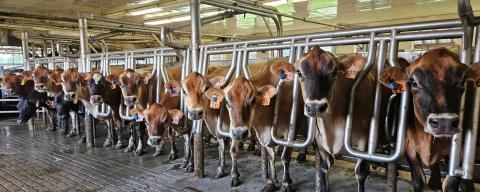
Photo credit: MacGlaflin Farm

Happy National Dairy Month! June was initially celebrated as “National Milk Month” in 1937 to stabilize dairy demand during a milk surplus1. However, the tradition has now evolved into “National Dairy Month” to celebrate the essential nutrients farmers provide their communities, dairy farm families, dairy traditions, and animal care2!
Dairy products are nutritional powerhouses, providing important sources of protein, calcium, potassium, vitamins, and more. In fact, drinking milk has benefits beyond just building healthy bones. Eating any dairy product is associated with reduced risk of hypertension, type 2 diabetes, and cardiovascular disease outcomes and mortality3. One 8-ounce serving of milk contains 8 grams of high-quality protein, including all nine amino acids, making it the best possible source for absorption4. Dairy products are an important part of a healthy diet regardless of age. In fact, the American Heart Association recommends consuming three daily servings of dairy products for adults and two to two-and-a-half daily servings for children5.
Dairy farming also remains an important part of New Hampshire’s culture and agricultural community. There are around 75 local, family-owned dairy operations in New Hampshire, with the average dairy farm having less than 120 cows. Not only do these farms produce nutritious food, but they also support local jobs and the local economy and contribute to the state’s rural character.
Cows are more than just cute animals to look at; they are physiological powerhouses. Dairy cows drink about 30-50 gallons of water daily (enough to fill a bathtub) and eat more than 100lbs of feed every day. For a human to eat as much as cows, they would need to eat 360 cheeseburgers and drink 600 cartons of milk every day6! Just one dairy cow makes an average of 8 gallons of milk daily, but many cows produce 12+ gallons daily. 12 gallons of milk means 8 gallons of ice cream or 10lbs of cheddar cheese7! This production is incredibly impressive, with dairy cows often compared to marathon runners. A high-producing cow typically requires 50,000-70,000 Calories per day to support their milk production and normal functions8. This is much more energy than a human marathon runner uses during a race, and cows are doing this daily! With continued advances in genetics, nutrition, and animal care, dairy farmers today are improving efficiency and farm sustainability while still prioritizing animal health and well-being.
Enjoy National Dairy Month by supporting your local dairy farmers! Visiting a farm stand, enjoying dairy products, or learning how milk gets from the farm to your table are great ways to support the dairy industry. Every cold glass of milk or delicious scoop of ice cream represents the dedication of dairy farm families across the country.
References:
1 June is National Dairy Month. 2020 Jan 25. IDFA. https://www.idfa.org/june-is-national-dairy-month.
2 Larson S. 2023 May 31. Celebrate National Dairy Month | American Dairy Association NE. American Dairy Association North East. https://www.americandairy.com/dairy-diary/national-dairy-month/.
3 Harvard. 2020 Oct 19. Dairy. The Nutrition Source. https://nutritionsource.hsph.harvard.edu/dairy/.
4 Health Benefits of Milk for Energy, Immunity, and Wellness | Dairy Farmers of America. 2019. Dfamilkcom. https://www.dfamilk.com/stories-inspiration/articles/health-benefits-of-milk.
5 Van Horn L, Carson JAS, Appel LJ, Burke LE, Economos C, Karmally W, Lancaster K, Lichtenstein AH, Johnson RK, Thomas RJ, et al. 2016. Recommended Dietary Pattern to Achieve Adherence to the American Heart Association/American College of Cardiology (AHA/ACC) Guidelines: A Scientific Statement From the American Heart Association. Circulation. 134(22). doi: https://doi.org/10.1161/cir.0000000000000462.
6 What Do Dairy Cows Eat? Foods That We Can’t . . . [accessed 2026 Jun 10]. https://www.ars.usda.gov/ARSUserFiles/50901500/px-based_v3.2/educ-matrls/pdfs/HO_what-cows-eat.pdf.
7 How Do Cows Make Milk? https://www.ars.usda.gov/ARSUserFiles/50901500/px-based_v3.2/educ-matrls/pdfs/HO_how-cows-make-milk.pdf.
8 National Academies of Sciences E, Studies D on E and L, Resources B on A and N, Cattle C on NR of D. 2021 Aug 30. Dry Matter Intake. wwwncbinlmnihgov. https://www.ncbi.nlm.nih.gov/books/NBK600610/.
Extension Services & Tools That Help NH Farmers Grow

Newsletters: Choose from our many newsletters for production agriculture
Receive Pest Text Alerts - Text UNHIPM to (866) 645-7010
Author(s)


