What is "Big Night" in spring and how can you help amphibians during this time?
-
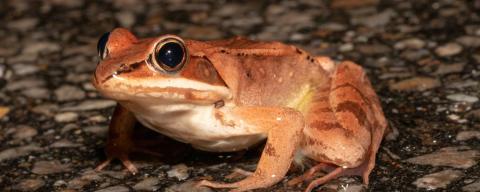
Wood frog

Have you ever heard the term Big Night and wondered what it refers to? In spring, amphibians migrate to vernal pools for breeding. There are specific weather conditions that determine when this migration occurs and there are several challenges that amphibians face on their journeys. Humans can help by joining local community science groups in safely moving amphibians across roads.
The Right Weather Conditions
Spotted salamanders, wood frogs, spring peepers, and other amphibians will venture out from the woods to make their annual journey to vernal pools in the spring on warm, rainy nights. The nighttime temperature will be above 40° F and the ground will have thawed. Although the term Big Night is used, there are multiple nights when this occurs. Depending on the weather and the environment, the timing of migration can vary throughout New Hampshire. It is usually sometime in March, April or May.
The Importance of Amphibians
Amphibians are important members of New Hampshire ecosystems. They are indicators of ecosystem health, they eat invertebrates and they serve as prey for many animals like hawks, foxes and coyotes.
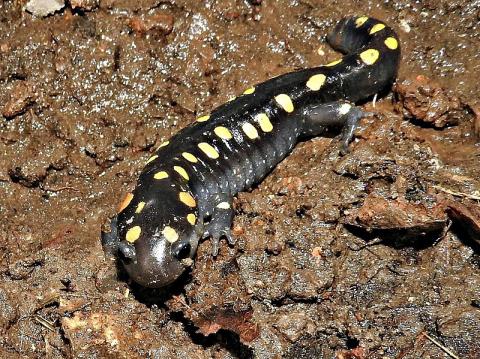
Spotted salamander
DID YOU KNOW?
Spotted salamanders that survive the metamorphosis from aquatic larvae into land-dwelling juveniles typically live about 20 years in the wild, though some have been reported as old as 30!
The Challenges of Migration
When migrating from woods to wetlands, amphibians face logistical challenges — most notably, busy roads. Frogs and salamanders are relatively small and can be hit by cars. To aid amphibians, tunnels and culverts can be designed to enhance their ability to cross the road. Read more about effective road crossings.
The Role of Community Science Groups
Community science groups can help by assisting amphibians while they are crossing roads. Volunteers can also collect data and raise awareness of safety during a Big Night, like encouraging people in their community to drive less after sunset.
The Harris Center for Conservation helps organize Salamander Crossing Brigades in the Monadnock Region, while other organizations and individuals maintain amphibian road crossing sites across NH and beyond.
For up-to-date information about a possible Big Night, you can view the Harris Center's Salamander Forecast tool, which tracks weather conditions and provides explanations regarding the probability of a Big Night.
Crossing Brigades in NH
- The Harris Center coordinates amphibian crossing efforts in Henniker, Keene, Nelson, Peterborough, Swanzey, Westmoreland, Wilton, and Winchester, NH.
- Tin Mountain Conservation Center coordinates a crossing on Bald Hill Road in Albany, NH. For more information or to sign up, contact Allison Byrd by email.
- Green Mountain Conservation Group and Chocorua Lake Conservancy coordinate efforts in the Chocorua Lake Basin, including a site in Chocorua, NH. For more information or to sign up, email GMCG or CLC.
- The Hartford Salamander Team and Lebanon Conservation Commission coordinate crossing brigade efforts at multiple sites in the Upper Valley, including Cornish, Plainfield, and Lebanon, NH.
- The Squam Lakes Association, Squam Lakes Natural Science Center, and Squam Lakes Conservation Society have teamed up to coordinate crossing brigade efforts in the Squam Lakes area. For more information or to volunteer, visit the Squam Salamander Brigade page or drop them an email.
Article reviewed by Haley Andreozzi, Extension State Specialist, Wildlife Conservation
Updated 3/31/2026 by Mikayla Cerney, Administrative Assistant, Carroll County
Author(s)


