
Imported cabbageworm, cabbage looper, diamondback moth, and cross-striped cabbageworm
Introduction
Caterpillar pests are major threats to brassica crops in New Hampshire, including cabbage, broccoli, cauliflower, kale, collards, and Brussels sprouts. The three most common species are imported cabbageworm (ICW), cabbage looper (CL), and diamondback moth (DBM). A fourth species, cross-striped cabbageworm (CSCW), is an occasional problem on farms near the Massachusetts border.
Feeding damage from these caterpillars reduces yield, quality, and marketability. Each species differs in size, feeding habits, and susceptibility to insecticides and predators. Effective management requires correct identification, weekly scouting, and integrated pest management (IPM).
Biology and life Cycle
Imported Cabbageworm, Pieris rapae
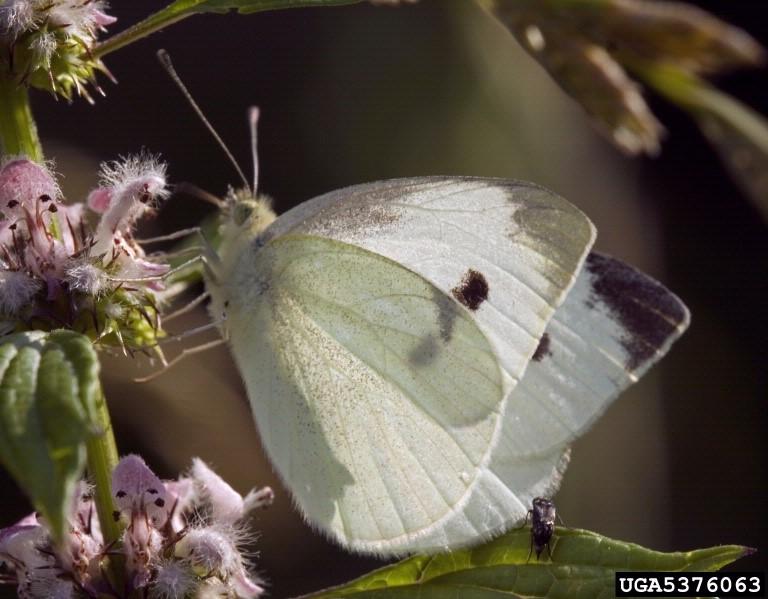
Imported cabbageworm (ICW) overwinters in New Hampshire as a chrysalis (pupa) attached to brassica debris. Adults, known as cabbage whites, are white butterflies with black wing spots (two on females, one on males) and darkened forewing tips.
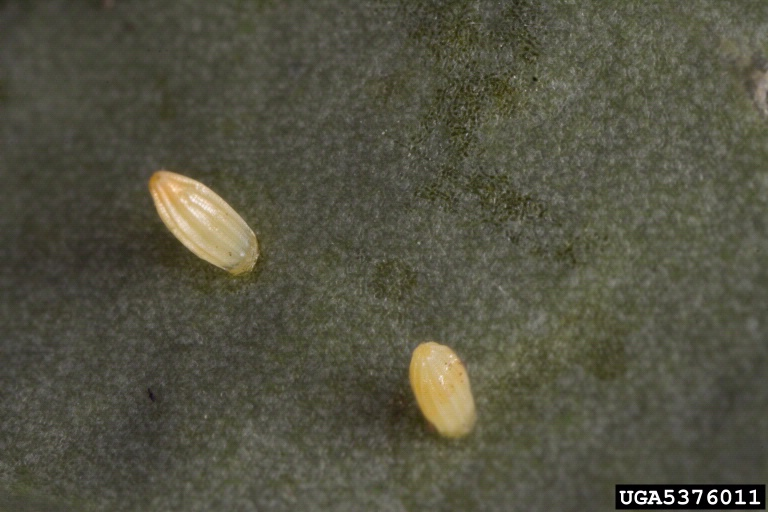
ICW eggs are bullet-shaped and laid singly on the undersides of leaves. Larvae are velvety green with a faint yellow stripe, which is more obvious in older larvae. They are slow-moving, easily camouflaged along leaf midribs, and feed/rest on the undersides of leaves. Pupae are bright green with pointed ridges.
ICW has 3-4 generations per year, with adults first appearing in May. Feeding creates irregular holes and frass (insect feces) contamination on leaves and in heads. Cabbage, collards, Brussels sprouts, and broccoli are more susceptible than Chinese cabbage, turnip, and kale. Among the brassica caterpillars, ICW is the easiest to control.


Cabbage Looper, Trichoplusia ni
Cabbage looper (CL) does not overwinter in New England. Instead, it migrates to New Hampshire during summer storms. Populations peak in late July August but vary from year to year.
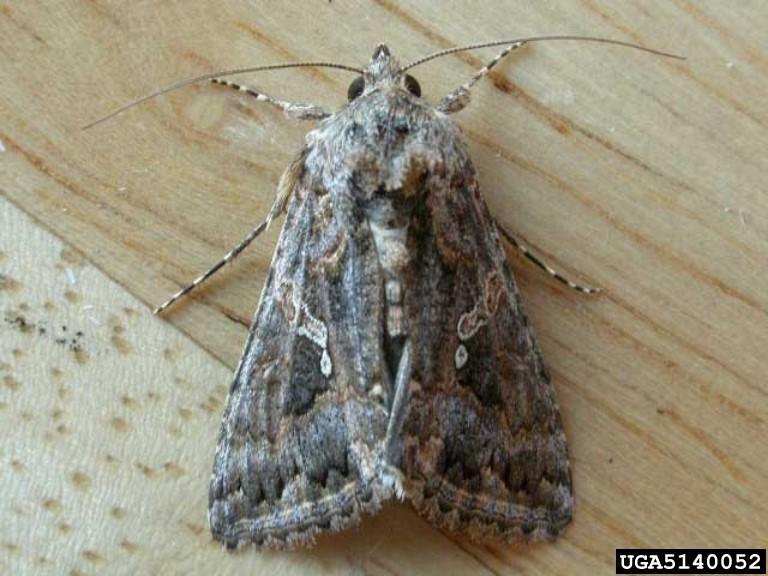
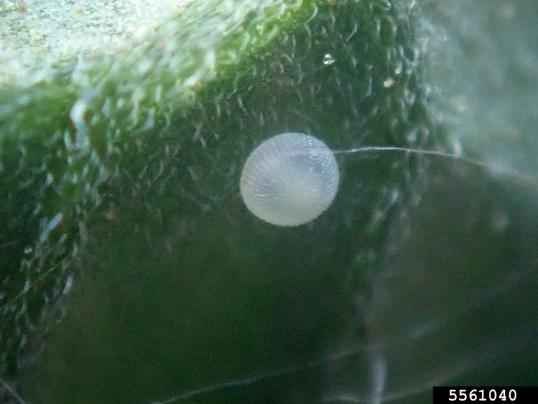
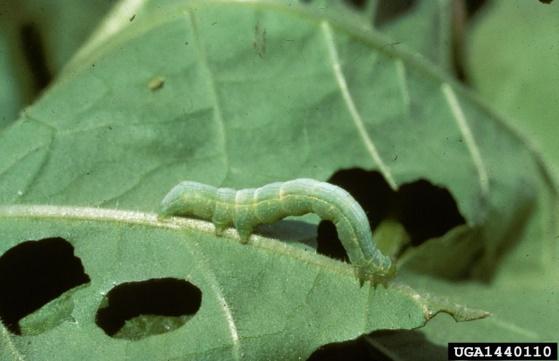
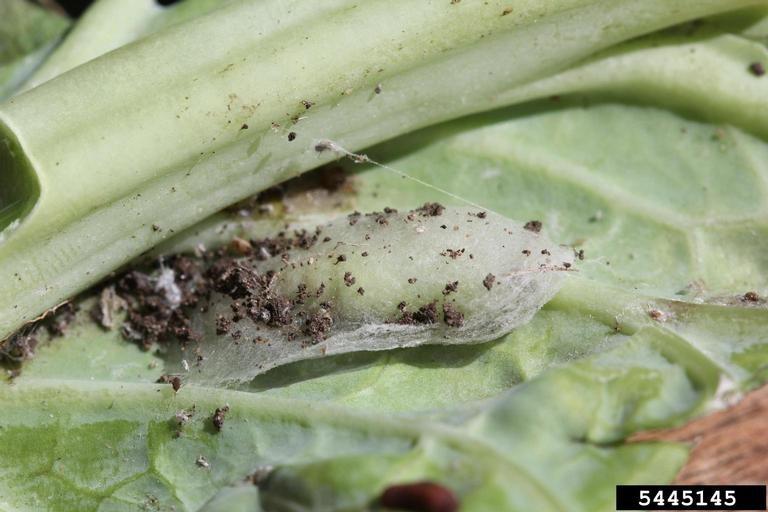
CL adults are mottled gray-brown moths with a silver figure 8 mark on their forewings. Eggs are round and laid singly on leaves. Larvae are smooth, bright green (head and legs also green) and move with a characteristic looping arch. Pupae form under flimsy, woolly cocoons on leaves.
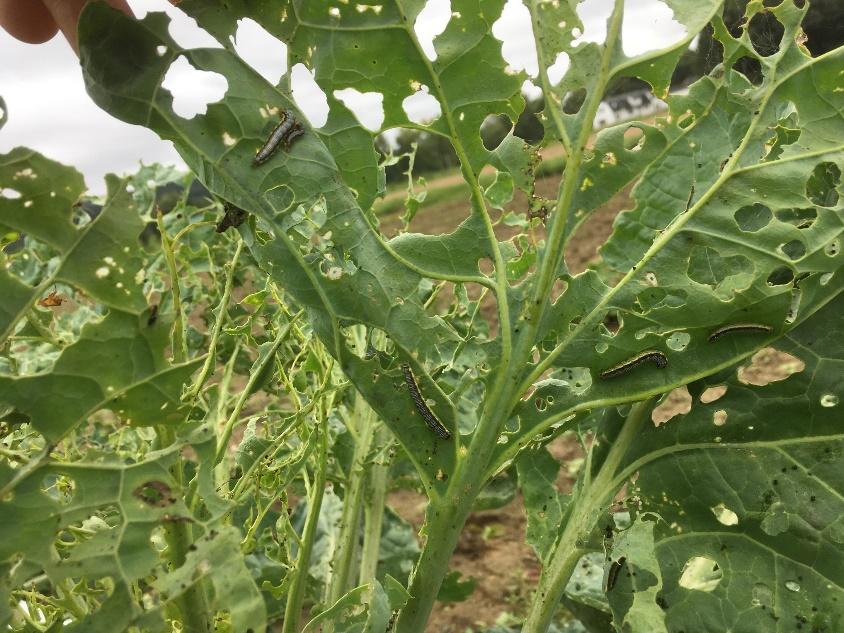
There are 2-3 generations per year. CL caterpillars feed on many vegetable crops, not just brassicas. Feeding causes large, ragged holes in leaves and heads. Larger larvae are more difficult to control, and insecticide resistance has been reported.
Diamondback Moth, Plutella xylostella
Diamondback moth (DBM) can overwinter as adults in New Hampshire during mild winters under crop residue or in protected sites like high tunnels and have been observed as early as May in New England. They also migrate north on storms.
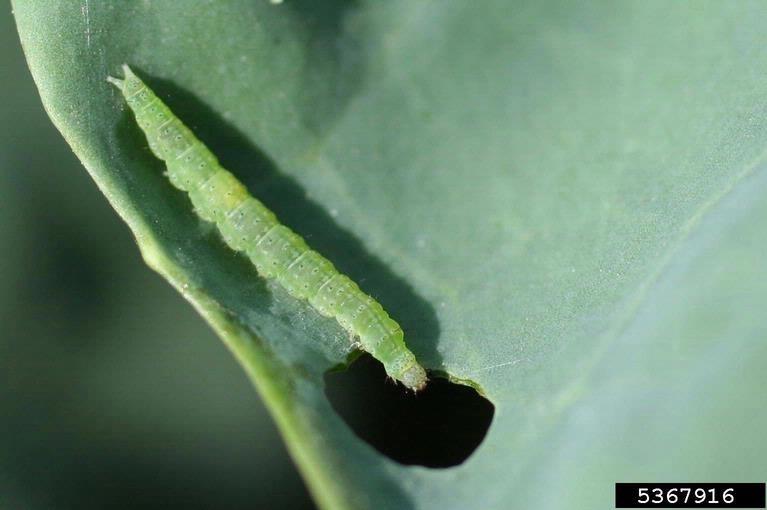
DBM adults are small, brown moths that rest with their wings folded, giving a tent-like appearance. Eggs are laid singly or in clusters. Larvae are small, light green, and tapered at both ends. When disturbed, they wriggle vigorously and may drop from leaves on silk threads. Pupae are enclosed in loose, netted cocoons on leaves.
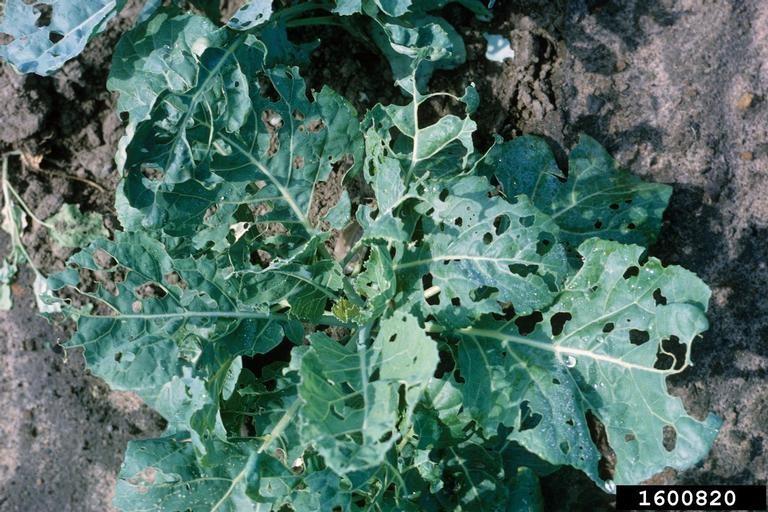
There are 3-4 generations per year. DBM feeding produces small holes in leaves. Young larvae create windowpane damage by chewing partially through leaves, leaving translucent patches. Damage is usually scattered across foliage rather than concentrated in heads.
DBM are the smallest brassica caterpillars and often worse in dry years. They are highly resistant to insecticides, though overwintered New Hampshire populations may be less resistant than southern migrating populations that have already been exposed to insecticides.




Cross-Striped Cabbageworm, Evergestis rimosalis
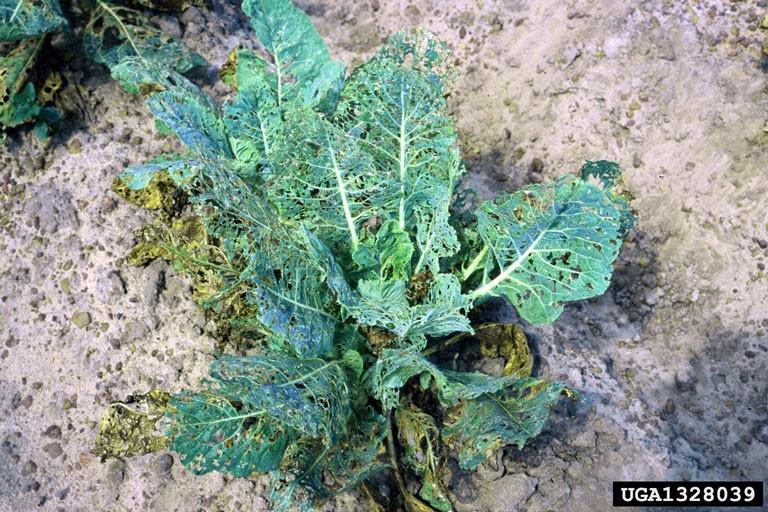
Cross-striped cabbageworm (CSCW) is a severe brassica pest in the southern U.S. and is now occasionally found in southern New Hampshire, particularly near the Massachusetts border. It does not overwinter here but instead, migrates north during the summer.
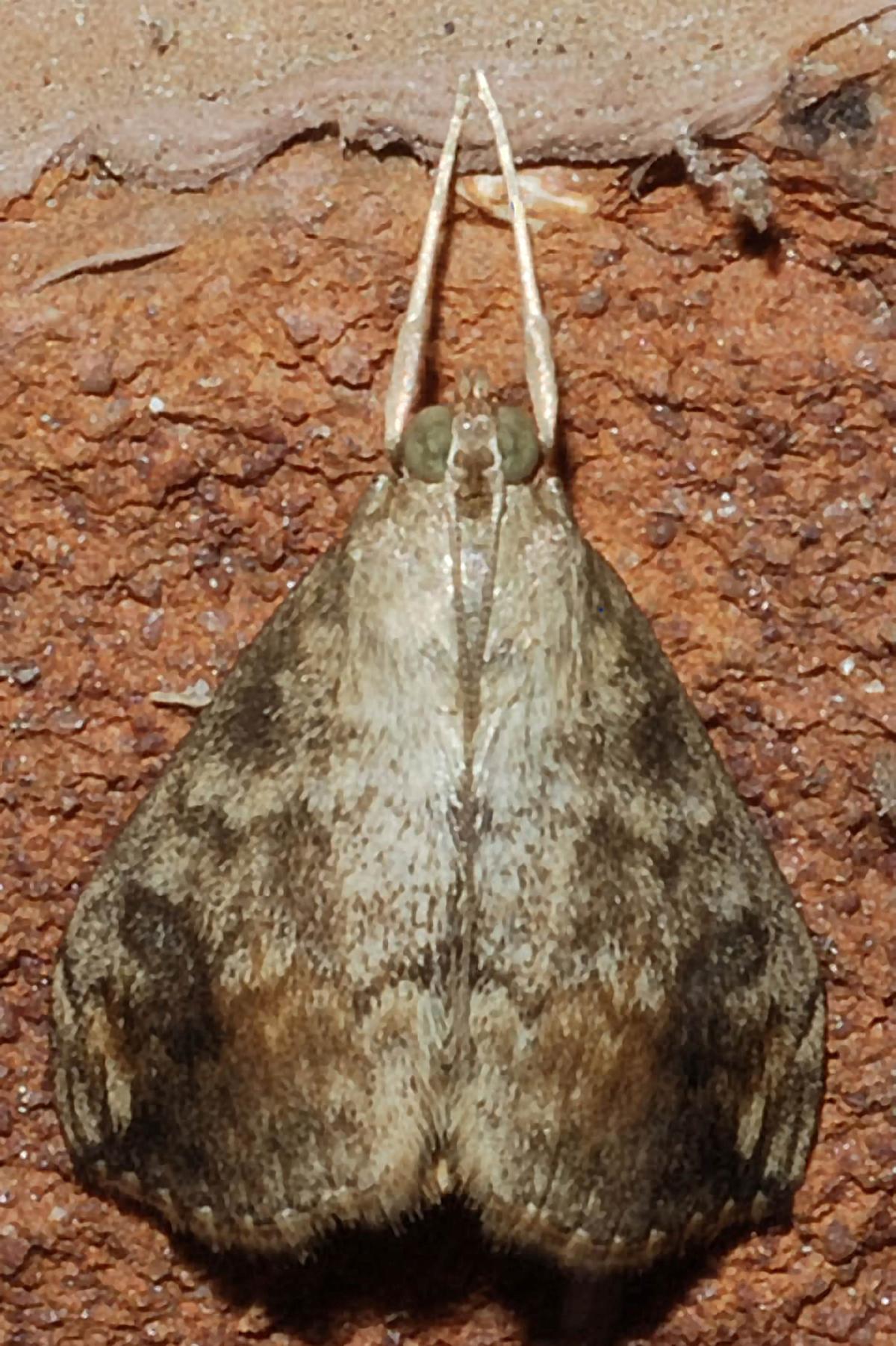
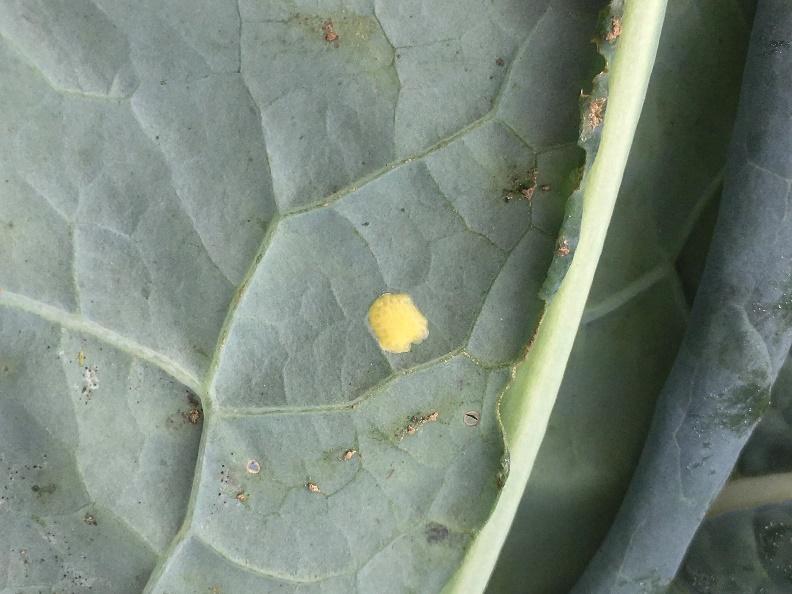
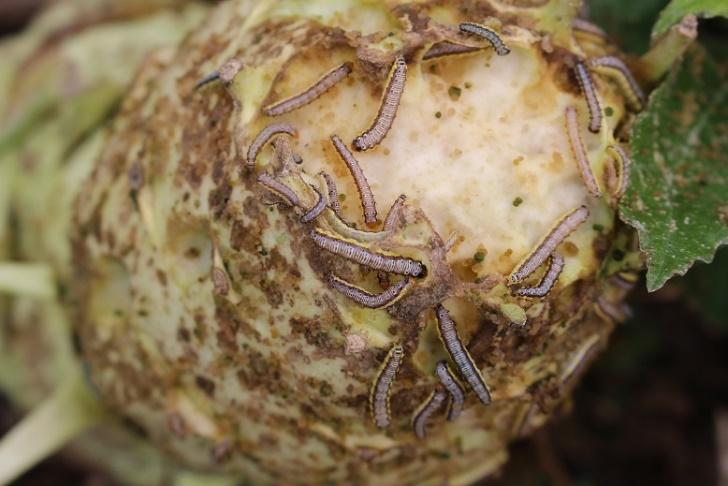
CSCW adults are triangular brown moths with wavy wing markings. Eggs are laid in clusters on lower leaves, so multiple larvae feed together on a single plant.
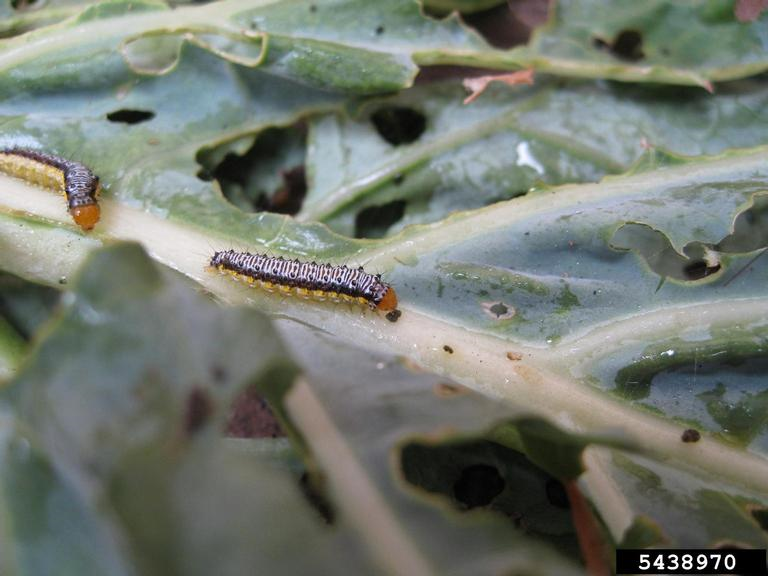
Young larvae are green-yellow with black dots and a bumpy texture. Mature larvae develop orange heads, with black and white stripes along the body, yellow undersides, and black bumps. Pupae are light brown and found near the soil surface.
There are 2 3 generations per year. Because larvae feed in groups, they can be very destructive even at low densities. They may skeletonize leaves, damage buds and sprouts, and burrow into heads. CSCW tends to appear later in the season, especially on Brussels sprouts, broccoli, and collards.

Pest Profiles and Management Thresholds
Imported Cabbageworm (ICW)
Key ID Features: Velvety, green, sluggish larvae with a faint stripe; size ranges from 0.12 to 1.2 inches.
Generations per Season: 3–4
Overwintering Stage: Chrysalis (pupa) on plant debris
Damage: Holes in leaves and frass (insect waste) in heads
Action Threshold: 35% infestation before heading, 20% during heading, 10% for leafy greens
Cabbage Looper (CL)
Key ID Features: Smooth green larvae up to 2 inches; moves in “inchworm” fashion.
Generations per Season: 2–3
Overwintering Stage: Does not overwinter in New England; migrates north
Damage: Ragged holes, especially in late-season crops
Action Threshold: Same as ICW
Diamondback Moth (DBM)
Key ID Features: Small larvae (<½ inch), segmented and pointed; wiggle when disturbed and drop on silk threads.
Generations per Season: 3–4
Overwintering Stage: May overwinter as adult in protected areas or during mild winters; also migrates north
Damage: “Windowpane” feeding on leaves
Action Threshold: Same as ICW
Cross-Striped Cabbageworm (CSCW)
Key ID Features: Larvae feed in groups; green/yellow with black dots, striped, and have an orange head.
Generations per Season: 2–3
Overwintering Stage: Does not overwinter in New England; migrates north
Damage: Skeletonized leaves; buds and heads destroyed; highly destructive even at low density
Action Threshold: 5% infestation
Monitoring and Scouting
Monitoring and scouting pests are key components of an integrated pest management (IPM) program. Scout weekly for brassica caterpillar pests, examining at least 25 plants at random in each field. Look for the larvae, frass, feeding damage, and note which species you find. Calculate the percentage of plants infested (caterpillar present or not present) and use for action thresholds. Check cabbage and broccoli as they begin to form heads, but be sure to scout leafy greens like collards and kale earlier.
Action thresholds:
- Imported cabbageworm, cabbage looper, diamondback moth
- Before heading: treat at ≥35% infestation.
- Cabbage/broccoli (heading to harvest): treat at ≥20%.
- Leafy greens: treat at ≥10%.
- Cross-striped cabbageworm
- Treat at ≥5% infestation (lower threshold because larvae feed in groups).
Pheromone traps can help track cabbage looper and diamondback moth flights. The most critical period for controls is just before head formation in heading crops.
Integrated Pest Management (IPM)
Cultural and Mechanical/Physical Controls
- Start with clean transplants and avoid planting near infested fields. Use locally grown transplants, when possible, to avoid importing insecticide resistant diamondback moth or cabbage looper from southern states.
- Incorporate crop residues directly after harvest to reduce debris and habitat for caterpillars.
- Rotate brassica crops away from previous brassica plantings.
- Control brassica weeds like yellow rocket, shepherd s purse, and wild mustard.
- Row covers or insect exclusion netting can work well to exclude moths from laying eggs on brassica crops and help prevent flea beetles and cabbage root maggot.
- Place netting immediately after planting/transplanting and bury the edges for the best results.
- Be aware of changes in humidity and temperature under row covers. Row covers are not recommended for summer brassicas.
- Do not place row covers in areas that have not been rotated because you may be trapping pests that have overwintered in this location underneath the netting.
- Heavy rains may wash small caterpillars off leaves.
- Pressure may be lower in drought years due to less storms bringing pests north.
Biological Controls
- Conserve natural enemies like parasitoids, predators, and pathogens.
- Provide habitat for natural enemies with flowering plants, cover crops, or border strips (buckwheat, phacelia, cilantro, fennel, sweet alyssum). Avoid brassica cover crop species.
- Avoid broad-spectrum insecticides early in the season to preserve beneficials.


Predator and Parasitoid Summaries for Each Pest
Imported cabbageworm (ICW)
Predators: Syrphid flies, ambush bugs, soldier bugs, paper wasps, ground beetles, rove beetles, ladybird beetles, spiders, lacewing larvae, birds
Parasitoids / Pathogens: Imported cabbageworm (ICW) — Cotesia glomerata (yellow cocoons, less effective), Cotesia rubecula (kills younger larvae, whitish cocoons), Pteromalus puparum (attacks pupae), tachinid flies (attack pupae), granulosis virus (Paillotellavirus pieris) in cool, wet weather
Notes: Cotesia rubecula has been released in New England and is more effective than C. glomerata.
Cabbage looper (CL)
Predators: Ground beetles, rove beetles, ladybird beetles, spiders, lacewing larvae, syrphid larvae, damsel bugs, paper wasps, birds
Parasitoids / Pathogens: Nuclear polyhedrosis virus (Borrelinavirus sp.), Cotesia marginiventris (larval parasitoid, commercially available)
Notes: Parasitism levels are usually low (<7%) in the Northeast; natural control mainly from predators and weather.
Diamondback moth (DBM)
Predators: Predatory beetles, spiders, predatory true bugs, syrphid larvae, paper wasps
Parasitoids / Pathogens: Ichneumonid wasps: Diadegma insulare and Diadromus plutellae, Cotesia plutellae (commercially available)
Notes: Parasitism can be significant but often insufficient alone; biological control success varies by year.
Cross-striped cabbageworm (CSCW)
Predators: Generalist predators (beetles, bugs, wasps, spiders, birds)
Parasitoids / Pathogens: Cotesia orobenae (larval parasitoid), Trichogramma brassicae (egg parasitoid, noted in some regions)
Notes: Less studied in the Northeast; tends to be a later-season pest.
Chemical Controls
- Use selective products first to protect beneficials (IRAC groups 5, 11, 28). Bacillus thuringiensis (Bt) works best on young caterpillars and is especially effective on DBM and ICW.
- Bt aizawai is newer than the Bt kurstaki strain and may be more effective on diamondback moth.
- Rotate insecticide modes of action (IRAC groups) to delay resistance. Avoid spraying insecticides from the same IRAC group back-to-back.
- Pyrethroids (Group 3) can be effective but are broad-spectrum. Use later in the season if needed to protect beneficials early.
- Good spray coverage is critical since caterpillars may be on the underside of leaves.
- Drop nozzles and spreader-stickers can help.
- Using 50 gal or more spray material per acre is also recommended since higher volumes provide better coverage.
- ALWAYS READ AND FOLLOW THE LABEL for temperature restrictions/efficacy, use on specific crops, crop stages, and pests, preharvest intervals, and other useful information.
- More information on chemical management can be found in the New England Vegetable Management Guide or by contacting your local Extension office.
Key Takeaways
- Scout weekly and identify which species are present.
- Treat only when thresholds are met to avoid unnecessary sprays and prevent resistance.
- Use cultural, mechanical/physical, and biological tactics first to suppress pests early.
- Begin with selective insecticides (Bt) and rotate modes of action to prevent resistance.
- Ensure thorough spray coverage for best control.
Resources
Hazzard, R., S.B. Scheufele, and L. McKeag. 2022. Caterpillars in Brassica Crops . University of Massachusetts Extension Vegetable Program. Accessed September 8, 2025. https://www.umass.edu/agriculture-food-environment/vegetable/fact-sheets/caterpillars-in-brassica-crops
Hazzard, R., S.B. Scheufele, and L. McKeag. 2025. Caterpillars in Brassica Crops . Vegetable Notes 2025 Vol. 37:9. Accessed June 12, 2025. https://www.umass.edu/agriculture-food-environment/vegetable/newsletter…;
Ng, M. and S. Ghimire. 2024. Caterpillar Pests of Cole Crops . University of Connecticut Integrated Pest Management Program. Accessed September 8, 2025. https://ipm.cahnr.uconn.edu/cole-crop-worms-caterpillar-pests/
New England Vegetable Management Guide. 2025-2026 edition. Cabbage Looper (Trichoplusia ni), Diamondback Moth (Plutella xylostella), and Imported Cabbageworm (Pieris rapae) in Cabbage, Broccoli, Cauliflower, And Other Brassica Crops: Insect Control. Accessed September 8, 2025. https://nevegetable.org/crops/cabbage-broccoli-cauliflower-and-other-brassica-crops/insect-control
Brassica Pest Collaborative: Cabbage Looper and Diamondback Moth Biology and Management Seminar. 2019. Accessed on July 18, 2023. https://www.youtube.com/watch?v=gglY3tgXlQE
Brassica Pest Collaborative: Imported cabbageworm and Cross striped cabbageworm Seminar. 2019. Accessed on July 18, 2023. https://www.youtube.com/watch?v=Y8mkjyv9bEc
Contact


