-
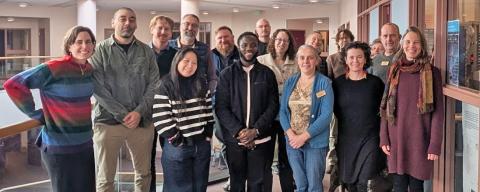
ADAPT core team members gathered at UNH on December 9, 2025 for a full-day retreat to align progress, goals, and strategy for integrated project success.
Back row, L to R: Ranjit Sawa, PhD., Ryan Smith, Wade Weber, Steven Roberge, Rich Smith, Ph.D., Analena Bruce, Ph.D., Heidi Asbjornsen, Ph.D., Aaron Guman, Mark Ashton, Ph.D., Mike Smith. Front row, L to R: Megan Glenn, Theresa Ong, Ph.D., Bernard Nyanzu, Kelly McAdam, Jess Gerrior, Ph.D., Alix Contosta, Ph.D.

Intro: Reflecting on 2025
Dear agroforestry enthusiasts,
The first snowflakes have fallen over the forests and farms of New England, and the ADAPT team is delightedly anticipating the winter holidays amidst a flurry of activity! We would like to take this moment of our first Winter Solstice issue to slow down and reflect on some amazing accomplishments this year.
Two summers ago, the ADAPT team hired two project managers, a field technician, and a team of undergrads who launched into conducting rapid field assessments of thirty agroforestry operations throughout New England. These assessments included a biophysical survey of the soils and vegetation present on each farm, as well as a series of socioeconomic interviews that gave us transdisciplinary insight into establishing and managing agroforestry systems.
Since then, we’ve hosted two co-design workshops for forest farming and silvopasture, connecting farmers, technical service providers, NRCS officials, and researchers from UNH, Yale, and Dartmouth. Collectively, we’ve identified research priorities for the remaining duration of our grant and gather expertise that will aid us in implementing demonstration sites in the upcoming year, and we are immensely grateful for everyone who shared their advice and experience with us.
This month, the ADAPT Project team gathered in Durham, NH for a full day focused on visioning and planning to align project objectives and forward actions. The morning centered on the goals of the original ADAPT proposal and updates from the lead scientists on each project component, followed by strategic targets for years three and five. After lunch, we collaborated on a roadmap for achieving these goals, integration across project components, and roles and responsibilities. The afternoon concentrated on research priorities, data management, and detailed planning for silvopasture, food forest, forest farm, and socioeconomic studies. By day’s end, we had strengthened our shared vision and set actionable steps to advance agroforestry innovation.
Keep scrolling to see more great advances in agroforestry among our partners in New England, recipes using agroforestry crops, and resources for aspiring agroforesters.
Sincerely,
The ADAPT Team
Issue #2
Quick Links
Feature Story
Educators Are Bringing Agroforestry to the Classroom
Technical Assistance & Peer Networking
Help grow our community of readers
Do you know someone involved in forest, farm, conservation, or food systems who would be interested in The New England Agroforester? We are growing our community of readers and invite you to share this subscription form with them.
Feature
Educators Are Bringing Agroforestry to the Classroom

Mike Smith and Megan Glenn, UNH Extension / NH Ag in the Classroom.
As interest in agroforestry grows quickly throughout New England, classroom teachers are eager to bring these ideas to their students. When Megan Glenn and Mike Smith launched a new cohort of K-12 educators this fall, they hoped to recruit about 10 participants. Instead, about double that number applied, and the program was capped at 21 with a waitlist. For Megan, the enthusiasm reflects a clear trend of educators seeking to connect agriculture and sustainability with learning.
The cohort began in October with a two-day intensive at an organic farm in Hanover, NH. Co-led by Teresa Ong, a Dartmouth agroforestry researcher and educator, and Krystal Bagnaschi, a Dartmouth graduate student, the kickoff introduced agroforestry concepts and social dimensions of farming in the region. Teachers visited research plots, helped plant trees, interviewed farmers at the Norwich Farmers Market, and toured Howling Wolf Farm. According to Megan, educators shared a sense of belonging to larger efforts and their conversations sparked ideas they could adapt for their classrooms.
The cohort program continues throughout the year with field trips and workshops highlighting agroforestry in various contexts and at different scales. At The Rocks Estate in Bethlehem, educators explored sustainable Christmas tree farming and ecosystem management. In January, the Maple Symposium will bring together educators from preschool through high school for networking and hands-on learning. Other trips include Ben’s Sugar Shack in Temple, the University of New Hampshire organic dairy, and Beaver Brook and Joppa Hill Farm in Bedford, where plans for a food forest are underway. In May, the group will visit Mill City Grows in Lowell, Massachusetts, to see how food forests thrive in urban spaces—a model that may be especially practical for schools.
The goal is to increase agricultural literacy among youth and introduce agroforestry principles, research, and career pathways. Rather than following a set curriculum, teachers design experiences that fit their context, such as lessons, field trips, or even planting food forests on school grounds. With support from partners like ReTreeUS, some educators are already exploring this possibility.
Building community is another priority. The overnight intensive gave teachers time to connect and share ideas, forming relationships that will last beyond the life of the grant. Megan sees this as essential because funding ends, but networks endure. “Ultimately, the community is the sustainable part of this work,” she explains. “If we can establish these ties, they will outlast the program funding.”
Field trips are open to the public, offering a way for educators who are curious about agroforestry to get involved. Plans are also underway for an online resource library featuring teacher-created materials. This first year is a pilot, but the enthusiasm from educators suggests a strong future for agroforestry education. It is about more than growing trees. It is about growing knowledge, community, and opportunities for the next generation.
Upcoming Opportunities for Educators and Community Members
- Maple Symposium (January): This event brings together educators from preschool through high school for networking and hands-on learning about maple sugaring and its role in sustainable agriculture. It is open to anyone interested in outdoor education and agricultural literacy.
- Ben’s Sugar Shack Field Trip (February): Participants will tour a working sugarhouse, learn about the history of maple production, and explore how traditional practices connect to modern sustainability efforts.
- Organic Dairy at UNH (March): This visit offers insight into sustainable dairy operations and research, providing ideas for classroom connections to food systems and environmental stewardship.
- Beaver Brook and Joppa Hill Educational Farm (April): Educators will see plans for a food forest and learn about design considerations for integrating agroforestry into educational spaces.
- Mill City Grows Urban Food Forest Tour (May): This trip highlights how food forests can thrive in urban settings, demonstrating that agroforestry is possible on a small scale and accessible for schools.
All events are open to educators and community members who want to learn more about agroforestry and sustainability. For details or to get involved, contact Megan Glenn at megan.glenn@unh.edu or 603-696-4020 or visit NH Agriculture in the Classroom webpage.
K-12 classroom educators participate as a cohort in a two-day agroforestry learning intensive at farm and forestry sites in New Hampshire. Photos by Megan Glenn.



Technical Assistance & Peer Networking
Transition To Organic Partnership Program (TOPP)
MOFGA Certification Services (MCS) encourages operators to consider submitting a request for Proposal for the Transition to Organic Partnership Program (TOPP). Project funding is capped at $100,000 per year, and technical assistance is an important part. To become an organic mentor, criteria include at least three years of organic production experience; good standing as a certified organic producer (or experience with organic certification); and a commitment of 45 hours/year working with a mentee farmer. For more information, contact MCS at 207-568-6030 or email certification@mofga.org.
Chestnut Improvement Network
The Chestnut Improvement Network (CIN) is a participatory network of chestnut growers developing resilient, productive cultivars for scaling commercial production in the US. CIN provides technical assistance to participating growers. Researchers work with breeding members on tree improvement, sharing selection criteria and assistance with record keeping, orchard planning, and practices for site preparation and management. To become a CIN breeding member, growers can establish an orchard of 250 or more open-pollinated seedlings using this order form for one-year-old bareroot trees to be shipped from January to March 2026. For more information, contact chestnut@missouri.edu.
New England Resources
American Farmland Trusts’ work in New England:
The Research Grove
Building a Regional Portrait of Agroforestry in New England: Early Findings from a 30-Farm Rapid Assessment
Ryan Smith is a forester and project manager at the University of New Hampshire with expertise in sustainable forest land use systems, including agroforestry, forest management, and forest landscape restoration. Ryan’s work with the ADAPT team supports establishing a multi-state network of agroforestry research and demonstration sites and coordinating research activities across sites. At The Society of American Foresters’ National Convention, Ryan presented alongside UNH Assistant Professor of Natural Resources and the Environment, Ranjit Bawa, on what the team is learning about land management strategies that fit local conditions and support climate adaptation and mitigation.
A First Look at What Agroforestry Really Looks Like Here
In summer 2024, our team completed a rapid assessment of 30 agroforestry farms across New England. A rapid assessment is a structured, short-term field study involving diverse data collection to provide an initial overview without waiting for long-term data. These farms were chosen because they had at least five years of experience with their systems, which allowed us to learn directly from early adopters.
We presented preliminary findings at this year’s North American Agroforestry Conference. Participants from all over the country are curious about how agroforestry works in New England’s unique landscape, which is up to 80 percent forested and characterized by small parcels, a long grazing history, and high participation in value-added production.
How We Structured the Research
Our work covered three areas. The biophysical team collected soil, vegetation, forage, and management practices. The economics team (Ranjit Bawa and Sajja Panta) conducted a SWOT analysis, identifying the strengths, weaknesses, opportunities, and threats specific to agroforestry in this region. The social science team (Analena Bruce, Umama Begum Ruba, and Jess Gerrior) studied the motivations and enabling conditions that allowed early adopters to begin practicing agroforestry.
Silvopasture Leads the Pack
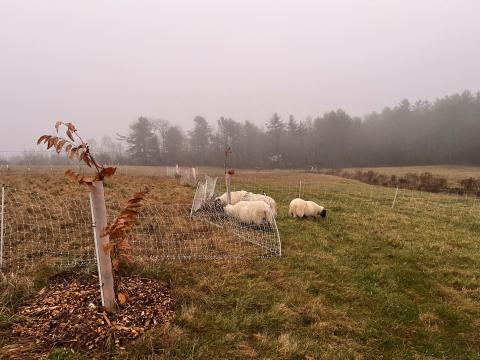
Silvopasture was the most common agroforestry system we found in New England. We used snowball sampling, which means we identified new farms through recommendations from farmers and partners. Examples included sheep grazing under apple trees at Flag Hill Cidery, chestnut systems at Breadtree Farms and Big River Chestnuts, and farms such as at Wild Harmony Farm, thinning woodlands to create managed grazing areas. At Howling Wolf Farm, farmers protect naturally regenerating trees in pasture, which is a low-input method for establishing trees known as “assisted natural regeneration”.
One consistent challenge in planted silvopastures is protecting young trees from livestock. Farmers use tree tubes, fencing, and careful rotation. Many said they would appreciate more guidance during tree establishment. In silvopastures involving thinning an existing forest, farmers were interested in learning more about how to establish forages in forest understories. In both areas, extension support can help. Extension agents are educators who work directly with farmers to answer technical questions, demonstrate practices, and share research-based recommendations. Our team aims to provide data that will help extension programs develop practical guidance for tree and forage establishment in silvopastures.
Insights from the Broader Agroforestry Community
At the conference, participation was strong in almost every session. Interest in forest farming was especially high. Farmers and foresters discussed cultivation of understory herbs such as wild ginseng, along with the conservation questions and state regulations that come with producing a rare and valuable plant. The Northeast Forest Farmers Coalition is working to help growers understand this regulatory landscape.
It is important for growers to document seed sources, planting locations, and applicable rules before planting rare or threatened species like American ginseng with the intention of eventually harvesting or selling the crops.
Regulations differ by state. In some places, home-grown ginseng can be sold with proper documentation, while in others it cannot. The more growers record at the time of planting, the easier it is to comply with rules later.
What We Are Working on Now
We are analyzing a broad dataset collected in a consistent way across 30 diverse farms. Working with this dataset has allowed us to connect field observations, farmer experiences, and quantitative measurements in meaningful ways. It also highlights the value of multiple ways of thinking.
One of the biggest strengths of our research is its interdisciplinary approach. We are using multiple academic disciplines, including quantitative and qualitative methods to learn from the successes pioneered by early agroforestry adopters in a region where agroforestry research has historically been limited.
Farmers often remind us that they have decades of applied experience. By combining their knowledge with systematic data collection, we hope to strengthen extension services across New England and support future practitioners.
Survey for Chestnut Growers
Tanner Rankin, a PhD student at the University of Missouri’s School of Natural Resources, is conducting surveys with chestnut growers to understand and describe their practices for on-farm for establishment and management of orchards and their perceptions of these practices, including their effectiveness and accessibility. The survey will take 10-20 minutes. A goal of the research is to further develop grower recommendations for chestnut growers throughout the Eastern and Midwestern U.S. To access the survey, click here. For more information, contact the University of Missouri’s Institutional Review Board (IRB) at 573- 882-3181 or muresearchirb@missouri.edu, or reach out to Tanner Rankin at tr3x3@missouri.edu or (610) 334-3384.
Practitioner Profile
Marty Castriotta: Building Food Sovereignty Through Perennial Agriculture
When Marty Castriotta describes this year’s Radically Rural event, his first word is “phenomenal.” Invited to facilitate the “Land and Community” track, Castriotta, a farmer, educator, and designer, spent a full day guiding participants through a hands-on exploration of what it means to reconnect with the land.
“The Hannah Grimes crew are some of the most incredible organizers I know,” he said, referring to the Keene-based Center for Entrepreneurship that coordinates Radically Rural. “They understand that our disconnection from the land sits at the root of so much.” Center Director Julianna Dodson, who has been exploring perennial solutions in agriculture, worked with Castriotta to design a program focused on regional food sovereignty and the role of agroforestry in that effort.
A Walking Story of Land and People
The day began with a walking tour through downtown Keene, New Hampshire, looking at how land use patterns have shifted over time. At each stop, Castriotta encouraged participants to think about the overlap between social and ecological systems, where community and land come together to form solutions.
The first visit was to Hundred Nights Shelter, where Castriotta has helped design and install a forest garden. “It was the perfect starting place,” he said. “People asked, ‘Why put so much energy into making this beautiful?’ The answer is that beauty is nourishment.” The group discussed the connections between food security and housing security, including the importance of spaces where residents can prepare and share food. Staff and volunteers from Hundred Nights spoke with participants before the group toured the site. “We are building perennial solutions for those in most need,” Castriotta said.
The next stop was the Monadnock Food Co-op, where participants met with Michael Faber to discuss the Co-op’s role as a regional food hub and its plans to strengthen ties with local farmers. The Co-op team shared ideas for turning a large unused area near the parking lot into a demonstration food forest with fruit and nut trees, understory plantings, signage, and seating for visitors. The vision is for the site to serve as an educational space that brings together community members and local producers.
The group then visited Brewbakers Café, where participants tasted chestnut muffins made by the farmers at Big River Chestnuts and heard stories about the chestnut’s potential as a regional food crop. Castriotta noted how the café illustrates the social dimension of agroecology. “Brewbakers brings together people from different parts of the world through coffee, herbs, and food,” he said. “They are using an urban café space for ecological restoration and community connection.” Owner Jeff Murphy spoke about following core values and how some choices that might not seem profitable at first have proven sustainable in the long run. “Green choices bring more people and more revenue,” he said.
From Trees to Table: Lessons from Yellow Bud Farm
After lunch, participants boarded a bus for Yellow Bud Farm in Northfield, Massachusetts. For Castriotta, this visit was a highlight. “They are phenomenal storytellers,” he said. “They show what perennial agriculture can look like at scale.”
The farm’s name comes from the yellow bud hickory, one of six key species grown on the site along with chestnut, persimmon, mulberry, bur oak, and honey locust. Trees are planted in alley-cropping systems with nursery beds of young tree stock between them. The team is selecting seed from the most productive trees in the Northeast and now maintains about 100,000 young trees. Their work focuses on developing tree crops for both human and animal consumption, emphasizing nut crops as potential sources of carbohydrates, protein, and oils for the region.
Visitors were treated to snacks made entirely from farm ingredients: nut and seed shortbread with whipped pawpaw cream, persimmon spread, and aronia-mulberry jam. “It was the alchemy of the land we were standing on,” Marty said.
Gathering Focus
The final stop of the day brought everyone to Orchard Hill Community in Alstead, NH, where participants from another Radically Rural track joined for a shared meal. Baker Noah Elbers prepared soup in a large cauldron over an open fire, served with Orchard Hill’s own organic sourdough bread. The gathering featured music and presentations from local food system leaders, including Melissa Hoffman of Sho Farm and Erik Schellenberg from Black Creek Farm and Nursery.
Chief Paul Bunnell (Gwilawato) of the Koasek band spoke about reestablishing perennial plants that can feed local communities. The event also featured new voices such as Emily Turner, a local farmer beginning a silvopasture system, and Marty’s niece Abbie Castriotta, a teacher at Woodstock (Vermont) High School and participant in the Climate Resilient Agriculture, Forestry, and Trade (CRAFT) program. Lionel Chute, district manager for the Sullivan County Conservation District, discussed recent grant funding that has supported food processing equipment, including nut-processing tools that will serve farms like Yellow Bud.
The evening’s panel discussion centered on how agroforestry fits into the equation of food sovereignty and resilience. Panelists spoke about the importance of involving food industry professionals in introducing regionally appropriate crops to local markets, helping people become familiar with foods that can be grown nearby. The conversation was serious and lively. “We really went there,” Marty said. “People saw that this is not just about growing tomatoes. It’s about a dramatic change in how we grow food and what that means for our communities.”
Participants noted that perennial systems integrate ecological, cultural, and social well-being. As one attendee reflected, “You can’t have food sovereignty unless everyone is fed.” Marty agreed. “Perennial systems allow for peaceful culture,” he said.
Looking Ahead
The response to the event was overwhelmingly positive. “Community participation was phenomenal,” Marty said. “Each stop showed how transformation happens. The landscape changes, people change, and neighbors begin to appreciate it as a beautiful place.”
Marty and his collaborators plan to build on this momentum. Similar programs may be offered in the future, combining field-based learning with community conversations about food resilience. Through his design business, Earth Craft, and his educational work with Keene State College, where he teaches agroecology and permaculture design, Marty continues to explore ways to connect built environments and living systems.
After 18 years operating a vegetable and pastured meat CSA through Village Roots Farm, Castriotta has shifted focus to perennial installations in visible, community-oriented spaces. He is also developing a “forest garden CSA,” where members receive trees, shrubs, and companion plants rather than weekly produce boxes. His team has expanded into building food infrastructure such as garden beds, arbors, barns, sheds, and greenhouses. “We are trying to show the whole picture,” he said, “how natural and built components can support each other.”
What comes next? “We are in transition,” Marty says. “But the goal is the same: to keep painting the picture of what change looks like and to help people see what is possible. The work is about connection—between people, systems, and generations. If we can keep that alive, the land will keep feeding us.”
The Learning Landscape

Chestnut soup
Image credit: Forager Chef
Article pairing: Growing chestnut agroforestry in New England (Regenerative Design Group)

Sam’s Persimmon-Hickory Nut Bread
Image and recipe credit: Linwood Thayer, North American Traditional Indigenous Food Systems (NATIFS)
Article pairing: Indigenous Food Resources (NH Indigenous Collaborative Collective)

Elderberry jelly
Image and recipe credit: Elise Bauer
Article pairing: What is the best way to grow elderberries? (UNH Extension)
Publications: Winter Reading & Listening
State-by-State Resource Libraries:
Connecticut Food System Alliance
Maine Network of Community Food Councils
Massachusetts Food System Collaborative
Rhode Island Food Policy Council
New England and Beyond:
NRCS Climate-Smart Agriculture and Forestry Mitigation Activities: The updated list includes 14 new activities, outlined in a webinar produced for FY 2025. Producers interested in applying new climate-smart activities across their operations may be eligible for financial support through NRCS conservation programs including Environmental Quality Incentives Program (EQIP), the Conservation Stewardship Program (CSP), and Regional Conservation Partnership Program.
American Farmland Trust’s Resource Library of fact sheets, reports, studies, and articles cover federal conservation policies and programs, state farmland protection strategies, securing land, and passing on the farm to the next generation.
Podcasts

Perennial AF is the Savanna Institute’s podcast about perennial agroforestry (AF). Listen to interviews, event recordings, and stories from the field featuring real agroforesters and perennial farmers each month.
Other podcast & radio episodes produced within New England:
- An Interview with organic farmer Becka Gagne of Schoodic Hollow Farm (University of New Hampshire)
- Of Hooting Bears and Agroforestry (New Hampshire Public Radio)
- Adjust for changing planet (New England Public Media)
- Eric Toensmeier of Perennial Solutions (The Permaculture Podcast)
- Silvopasture could be a key adaptation to a changing climate (Connecticut Public Radio)
Events Calendar
New England’s NOFA Winter Conferences
Connecticut: CT NOFA’s Winter Conference
Saturday, March 7, 2026 in Middletown, CT. Featuring a series of virtual workshops on March 3-5 in the lead up to the full day, in-person gathering and celebration of the Bill Duesing Organic Living on the Earth award. Follow this link for more information, .
Maine: MOFGA’s Farmer to Farmer Conference
February 7-9, 2026 in Portland, ME. Featuring farm tours and walk-and-talk sessions, Cabbage (MOTH) Hour, and keynote by members of Agricola Farm, who will share about their worker’s cooperative and navigating change on the farm while upholding core values and healthy relationships with fellow farmers. Follow this link for more information.
Massachusetts: NOFA-MA Winter Conference
Saturday, February 28, 2026 in Amherst, MA. Featuring Keynote Speaker Dan Kittredge, speaking on “Living Soils: Unlocking Nutrient Density.” The conference is part of a broader effort to advance the Massachusetts Healthy Soils Action Plan. Follow this link for more information.
New Hampshire: NOFA-NH Winter Conference
March 7, 2026 in New London, NH. This year’s theme, Taking Root: Nourishing Community, honors the deep connections between land, people, and practices that sustain us. Follow this link for more information.
Rhode Island: Growing Our Region: Northeast Organic Farming Symposium
December 16–17, 2025 online, free. Features a workshop on Growing Organic Chestnuts as a Commercial Crop plus technical content grounded in research, innovative methods, and real-world production challenges relevant to the Northeast. Follow this link or more information.
Vermont: NOFA-VT Winter Conference
February 14-15 in Colchester, VT. Keynote speaker Ira Wallace is a worker/owner of the cooperatively managed Southern Exposure Seed Exchange and is creating an African Diasporic Seed Collection. Follow this link for more information.
Meet You Greens
Meet Your Greens is Northwest Connecticut’s Green Drinks happy-hour network, with opportunities to make connections, exchange news, brainstorm ideas, and plant seeds for collaboration. All are welcome; no reservations or RSVP necessary. Follow this link for more information.
2026 Northeast Grazing & Livestock Conference
January 30-31, 2026 in Manchester, NH or online. This year’s event is a confluence of the Northeast Grazing & Livestock Conference & the Northeast Pasture Consortium Annual Meeting. Keynote speakers Loren and Lisa Poncia of Stemple Creek Farm. A 15% early-bird discount is offered before December 18, 2025. Follow this link for more information.
2026 Northeast Dairy Innovation Summit
March 10 – 11, 2026 in Albany, NY. Hosted by the Northeast Dairy Business Innovation Center. Tracks on dairy farm innovation and modernization, processing modernization and expansion, and dairy workforce development. For more information, follow this link to their website.
Sausage Master Class
February 21-22, 2026 at 1787 Butchery, Randolph, VT. Registration closes two weeks before the training starts. For more information, contact the Center for Agriculture & Food Entrepreneurship (CAFE) by emailing Taylor.Paone@VermontState.edu or visit the course registration page.
Forestry Technician Industry Recognized Credential (IRC)
February – April 2026 online and at University of New Hampshire and field sites. Offered by NH Timberland Owners Association (NHTOA). Includes a virtual session followed by field skills at University of New Hampshire and an industry tour. For more information and to register or be added to the waiting list, go to Industry Recognized Credential webpage or contact Doug Cullen, Workforce Development Manager.
New England Society of American Foresters (NESAF) Annual Meeting 2026
March 18-20, 2026 in South Portland, ME. This year’s theme will be: Forest Reciprocity: What Can You Do for Your Forest and What Can Your Forest Do for You? Follow this link for more information.
Seeding Success: Funding & Finance Opportunities
Catalyzing Agroforestry Grant Program
The 2026 Catalyzing Agroforestry Grant Program (CAGP) application deadline is March 3, 2026. Applications after that date will be considered for the next round. The CAGP supports agroforestry practices such as alley cropping, forest farming, riparian buffers, silvopasture, windbreaks, and urban food. It also supports the Agroforestry Regional Knowledge (ARKx) Exchange for ecocultural learning, workforce development, and networking among producers and partners. Nationwide; 100+ producers from 18 states were awarded funding for agroforestry projects in the first two grant cycles. For more info, click here.
Acquisition Grant Program for Partners
Northwest Connecticut Land Conservancy (NCLC) offers the Acquisition Grant Program for Partners to help partner land trusts to quickly complete acquisition projects and contribute to regional conservation goals. Grant awards will fund land purchases in NCLC’s service area (not including transaction costs). For more information, click here.
Funds for Drought Relief and Recovery in Vermont
Vermont Farm Fund Emergency Loan can assist producers with urgent drought relief or recovery needs with loans of up to $15,000. The Farmer Emergency Fund provides funds of up to $2,500 for commercial farmers who are NOFA-VT to assist with recovery from natural and unnatural disasters. Ongoing funding opportunities in Vermont also include Farmstead BMP, Pasture and Surface Water Fencing, Seeding and Filter Strip, and Conservation Reserve Enhancement Programs (CREP).
NH Climate Resilience Grants
Through the NH Climate Resilience Grants Program, the NH Association of Conservation Districts supports farmers to meet increasing challenges of extreme weather events, frequent and prolonged droughts, and increased pest pressures. Applications are due February 1, 2026. For more information about the grant program, past recipients, educational opportunities, and additional funding opportunities for climate mitigation and adaptation, click here.
Fund-A-Farmer Grants
Food Animal Concerns Trust (FACT) offers two Fund-A-Farmer Grants in Vermont and New Hampshire: Fund-a-Farmer Welfare Improvement Grants up to $3,500 each and the Fund-a-Farmer Systems Change and Innovation Grant for up to $10,000. This year’s grant deadline is January 3, 2026. For more information including application questions and scoring criteria, click here.
Black Farmer Fund’s Rapid Response Fund
Black Farmer Fund (BFF)’s Rapid Response Fund provides funds of up to $10,000 to address emergencies that disrupt operations for businesses and organizations led by Black farmers and food business owners in the northeast. Decisions for funding are made by a community-led committee. Rolling deadline. For more information, click here.
More places to find grants:
- Ambrook: Farm Funding Library
- Community Enterprises, Inc. (CEI): Small Business Grant Resource Guide
- Maine Farmer Resource Network: Grant Writing Resource
- Maine Organic Farmers & Gardeners Association (MOFGA): Grant Writing Workshop for Farmers
Support for grant-seekers:
Stepwell Strategies’ USDA Grant Writing program provides low-cost and no-cost services in the Northeast. With funding from the Northeast Regional Food Business Center, the program offers full-service support or self-driven, guided support to build participants’ capacity for grant writing and development. The program prioritizes organizations led and serving historically underserved communities and individuals. For more information, click here.
Classifieds
Common Good Vermont regularly lists job postings in agriculture, sustainability, and related fields.
Feed-Finder Marketplace lists feed sources for purchase. Vermont and New York are the most active areas but listings are welcome from any state. For more information, contact the Vermont Agency of Food and Markets at AGR.Helpdesk@vermont.gov.
Photo Synthesis: Reader-Submitted Images
ADAPT Principal Investigator and Professor of Ecosystem Ecology, Heidi Asbjornsen, PhD shared these photos from a recent kitchen experiment with pawpaw, one of many agroforestry crops. Click here for the recipe for these brilliant holiday cookies and check out more recipes in this issue’s Learning Landscape section.
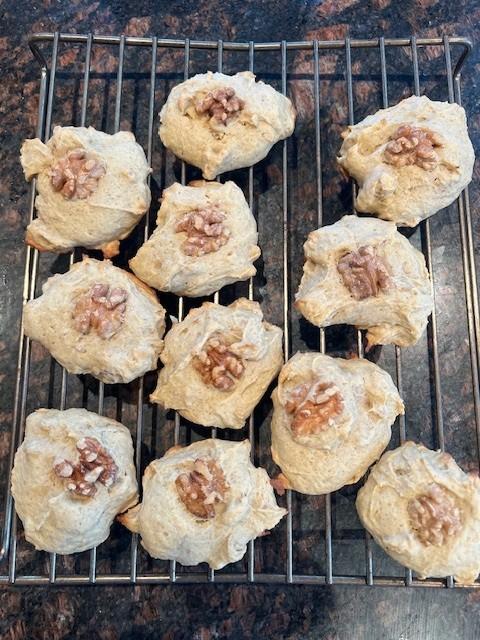


Help us grow this section! Send your images to: agroforestry@unh.edu. Images will only be shared with author’s permission.
UNH Land, Water, and Life Acknowledgement
As we all journey on the trail of life, we wish to acknowledge the spiritual and physical connection the Pennacook, Abenaki, and Wabanaki Peoples have maintained to N’dakinna (homeland) and the aki (land), nebi (water), olakwika (flora), and awaasak (fauna) which the University of New Hampshire community is honored to steward today. We also acknowledge the hardships they continue to endure after the loss of unceded homelands and champion the university’s responsibility to foster relationships and opportunities that strengthen the well-being of the Indigenous People who carry forward the traditions of their ancestors.
ADAPT TEAM
PRINCIPAL INVESTIGATORS:
Heidi Asbjornsen, Ph.D., University of New Hampshire
Mark S. Ashton, Ph.D., Yale University
Ranjit Bawa, Ph.D., University of New Hampshire
Alix Contosta, Ph.D., University of New Hampshire
Kate Korbas, Ed.D., University of New Hampshire
Theresa W. Ong, Ph.D., Dartmouth College
Steven Roberge, University of New Hampshire
PROJECT MANAGERS:
Aaron Guman, University of New Hampshire
Ryan Smith, University of New Hampshire
COMMUNICATIONS SPECIALIST:
Jess Gerrior, Ph.D., University of New Hampshire

