Go from NH gardener to Granite State Food Hero!

One in every nine NH residents is food insecure, including one in every seven NH children.1
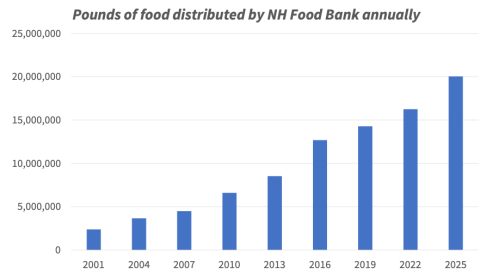
Since the pandemic, food prices have increased by about 25%, outpacing overall inflation.2 Almost two-thirds of NH residents who report having insufficient food cite affordability as the reason.3 Demand for emergency food assistance has never been higher, with NH Food Bank distributing more than 20 million pounds of food for the first time in 2025. At the same time, federal funding for programs that have successfully provided fresh, local produce for food insecure NH families, like NH Food Bank’s NH Feeding NH program, has been cancelled.4 NH Food Bank’s production garden closed in 2026.5
Home gardeners can improve food security in their communities by growing and donating produce to food pantries. Here’s how to go from gardener to Granite State Food Hero!
go from gardener to granite state food hero!
- Commit to growing produce for your neighbors: The most important step is commitment. Write down your “why”, visualize your goal, believe in yourself, and the rest will follow. You can do this!
- Choose a food pantry: Donating directly to your local food pantry builds community and ensures produce stays as fresh as possible from garden to plate. Check out NH Food Bank’s searchable food pantry map.
- Reach out: Make a phone call or send an email using the pantry’s contact information. Let them know you are eager to donate and want to make sure they will accept fresh produce.
Most food pantries welcome these donations, but those new to fresh produce may need time to work out logistics. Be patient as many are volunteer-run and already stretched thin. - Nurture & grow the relationship: Like working in the garden, you get out what you put in. Good communication is key. Be respectful, friendly, and accommodating.
- Grow fresh produce: Put all that gardening knowledge to use! Challenge yourself to keep learning and growing as a gardener and a community member.
- Harvest, clean, and store produce properly: Keep tools, washing bins, storage containers and prep areas clean. Place washed produce in clean coolers on ice packs for delivery. Get more food safety tips for home gardeners.
- Donate fresh produce to one or more NH food pantries: Count, weigh, bag, and record the produce you donate. Finalize your delivery logistics with the food pantry staff, including what you are delivering, when you will arrive, and what bins/trays you will need them to provide for your delivery. Make sure to follow their delivery guidelines.
You can also bring donations to NH Food Bank Monday – Friday from 8am – 4pm at 700 East Industrial Park Drive, Manchester, NH 03109. Pull up behind the building and their staff will load the product onto a cart, weigh it, and provide you with an optional tax receipt. - Celebrate your accomplishments! Thank you for becoming a Granite State Food Hero! Reach out to Amy Hollar for support and to share your accomplishments.
Everyone deserves to be well-nourished. No amount is too small to give. Together we can make a difference.
References:
- NH Food Bank (2026). Hunger in New Hampshire. https://nhfoodbank.org/get-to-know-us/hunger-in-nh/
- NH Fiscal Policy Institute (2024, March 4). Food Prices Have Increased Faster Than Overall Inflation Since the Pandemic. https://nhfpi.org/resource/food-prices-have-increased-faster-than-overall-inflation-since-the-pandemic/
- United States Census Bureau (2024, October 3). Phase 4.2 Cycle 09 Household Pulse Survey. https://www.census.gov/data/tables/2024/demo/hhp/cycle09.html
- NH Food Bank (2025, April 21). NH Food Bank’s Response to Federal Food Assistance Changes. https://nhfoodbank.org/federal-funding-updates/
- NH Food Bank (2026). Production Garden. https://nhfoodbank.org/what-we-do/production-garden/
Want to grow your gardening knowledge while giving back? Learn more and apply to become a UNH Extension Master Gardener!
Seacoast NH 4-H welcomes home gardeners ready to commit to growing produce for donation to sign up for Plant a Row. Participants receive a free garden starter kit. Learn more & sign up for Plant a Row in Strafford County 4-H and Rockingham County 4-H.
Want to do more to end hunger in NH? Regional food access coalitions are working together across NH. For example, the Carroll County Food Access Network improved summer access to fresh produce for at-risk youth through coordinated efforts that included garden produce donations. Learn more about NH food access coalitions & sign up here.
Check Out Our New Health & Well-Being Page
Our specialists help create healthy people and healthy places in New Hampshire.
Featured LINK
Mental Health Resources for New Hampshire - a printable county-specific guide to help New Hampshire residents find local, state, and national mental health resources.
The University of New Hampshire Cooperative Extension is an equal opportunity educator and employer. UNH, U.S. Dept. of Agriculture, and New Hampshire counties cooperating. Direct inquires to unh.civilrights@unh.edu. | © Robert Kneschke - stock.adobe.com
Author(s)


