
Please excuse our appearance while this webpage is being updated.
About the UNH Extension Pollinator Garden Certification Program
When you certify your garden or landscape through the UNH Extension, you become part of a growing community committed to creating meaningful habitat for pollinators through sustainable, science-based practices. Grounded in research, education, and shared learning, the program supports gardeners of all experience levels in creating and maintaining safe, resilient habitat for native bees and other pollinators.
The Importance of Pollinators
Pollinators—including bees, butterflies, moths, beetles, flies, birds, and other animals—are essential to healthy ecosystems and agriculture. By transferring pollen between flowers, they help plants reproduce and support nearly 90% of flowering plants and more than two-thirds of global food crops.
Pollinators Need Our Help
Many pollinator populations are declining because of habitat loss, invasive species, pests and diseases, pesticide exposure, and changing environmental conditions. Fortunately, home landscapes, schools, businesses, and community spaces can all provide valuable habitat.
Use the resources on this site to learn about pollinator habitat, native plants, and the pollinators that call New Hampshire home. Then, support them by planting a pollinator garden big or small. Together, these habitats can strengthen local pollinator populations and the ecosystems they support.
Create a Pollinator Habitat

FOOD DIVERSITY
A Buffet of Blooms
Plant a "succession of blooms" from early spring through late fall. Aim for at least three different native plants for each season. Using a variety of shapes and colors ensures every local pollinator finds the specific nutrients they need. Choose tubular flowers for hummingbirds and flat-topped clusters for butterflies.

WATER SOURCE
Safe Hydration
Provide a consistent water source for drinking and nest-building. If you don't have a natural source in a pond, lake or stream create a source with a birdbath or puddling dish. Add stones or marbles as "landing pads" to prevent drowning, and refresh the water twice weekly to keep it clean and mosquito-free.
Note: A water source is not required for certification
Image credit: Nikokvfrmoto/stock.adobe.com

SHELTER
Nesting & Overwintering Sites
To provide nesting and overwintering sites, leave some areas of your garden a little messy. Keep hollow-stemmed plants standing through the winter, leave a patch of bare, undisturbed soil for ground-nesting bees, and wait until late spring to clear away leaf litter. These natural materials provide the essential insulation and protection pollinators need to survive the New Hampshire winter.
Image credit: Volha/stock.adobe.com

PESTICIDE FREE
Safe Habitat
Protecting your habitat means minimizing or eliminating the use of chemical pesticides, especially "systemic" insecticides like neonicotinoids which can remain in plant tissues for a long time. Practice Integrated Pest Management (IPM) by focusing on hand-picking pests or using physical barriers first.
Planting for Pollinators: Making the Best Choice
Natives, Nativars, and Cultivars: What’s the Difference?

RUDBECKIA LACINIATA
Native Plants
The original wild form of the plant. Native plants are the natural food source for native pollinators. They have co-evolved with local insects, offering the most reliable food sources. Adapted to our New England climate and soil, they are resilient and hardy making them easy care plants.
Image credit: Amy Mitchell/stock.adobe.com

RUDBECKIA HIRTA "CHERRY BRANDY"
Nativars
These are plants bred from the native species for a specific trait like flower color or size. Some nativars have similar value as natives while others may have lower-quality nectar or foliage that caterpillars can no longer eat.
Image credit: Serbian Teacher/stock.adobe.com

RUDBECKIA LACINIATA "GOLDQUELLE"
Cultivars
Cultivars are bred for better disease resistance, strong root systems, seed germination, and human aesthetics like double blooms and altered colors. Some have less pollen or nectar, double blooms making the pollen inaccessible or may be unrecognizable to pollinators.
Certification Tip: While they can add beauty to your landscape, cultivars do not count toward the requirement of 3 flowering food sources for each season.
Image credit: Corry Anne/stock.adobe.com
Meet the Pollinators
-

Bees & Wasps
New Hampshire is home to over 350 species of wild bees. Bees are our most effective pollinators because they intentionally collect pollen to feed their young, while wasps pollinate secondarily while drinking nectar. While bumble bees form social colonies, most native bees lead solitary lives.

-
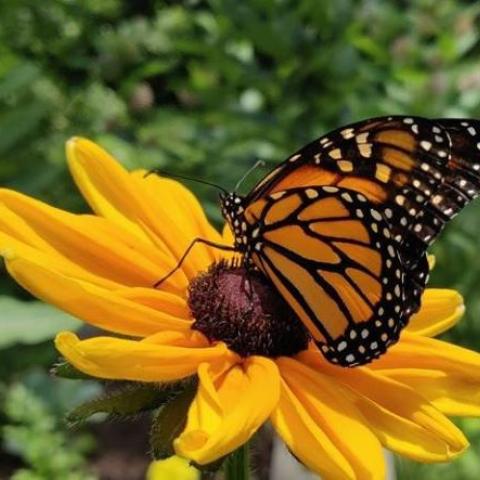
Butterflies
Butterflies feed on floral nectar, inadvertently moving pollen between blooms as it sticks to their bodies. Female butterflies depend on specific native host plants (such as milkweed for Monarchs) to lay eggs for their caterpillar stage.

-

Beetles
Beetles assist with flower pollination when foraging for food, playing a vital role in habitats where bees are less abundant.
Image credit: Dmitry Zhukov/stock.adobe.com

-

Birds
Birds are recognized as key animal pollinators. In New Hampshire, the primary avian pollinator is the Ruby-throated Hummingbird, which is attracted to bright red, tubular flowers.
Image credit: Steve Byland/stock.adobe.com

-

Moths & Flies
Moths belong to the same order (*Lepidoptera*) as butterflies, but they are far more numerous in New Hampshire with approximately 2,200 moth species compared to roughly 80 butterfly species. Most moths are nocturnal, sipping nectar from fragrant, night-blooming flowers, though some—like the hummingbird moth—are active during the day. Flies, particularly syrphid flies (also known as flower flies or hover flies), feed on nectar and pollen. Many are harmless bee mimics with black and yellow striping that visit large, flat, pale flowers and inadvertently move pollen on their bodies as they feed.
Image credit: Alina (Harris) Cypher / Sideman Lab

-

Mammals
New Hampshire is home to a broad diversity of more than 350 species of wild bees. These are our most active pollinators.

Join the Certified Pollinator Garden Community
Certifying your garden through UNH Extension's Pollinator Garden Certification Program joins you with a statewide community dedicated to creating vital, resilient habitats.
Before starting your application, make sure your habitat is ready to qualify. Tip: Print the PDF application below to use as a worksheet while planning your garden.
Habitat Criteria
- A Buffet of Blooms: A minimum of 3 native plant species blooming in each season (early, mid, and late)—for a total of 9 native species.
- Caterpillar Host Plants: At least 4 native host plants to nourish larvae. (Check our native plant list below to verify.)
- Shelter & Overwintering Sites: At least 3 natural shelter features (e.g., leaf litter, hollow stems, rock piles, or bare ground).
- Pesticide Protection: Zero chemical pesticides, or strict use of Integrated Pest Management (IPM) practices.
What to Have Ready Before You Apply
- Garden Sketch: You will need to include a simple sketch of the garden area you are certifying, displaying where 9 of your native host/nectar plants are located.
- Plant List: Use the plant list embedded within the printable application form to check off your existing plants and plan any needed additions.
- Application Fee: A $30 non-refundable application fee. This fee helps to cover the time it takes to review and process your application, and to mail out your certificate.
UNH Extension staff and Master Gardener volunteers are here to help you along the way. Whether you have questions about gardening, pollinators, or about the certification program, we welcome your questions. To reach out, email us at pollinator.gardens@unh.edu, call us at 1-877-EXT-GROW (398-4769) or reach us through our webform at extension.unh.edu/ask.


Put Your County on the Map!
Map of certified Pollinator Gardens coming soon!

Need a Sign?
Updated signs coming soon!
Love to garden? Grow with us.
Join a community of passionate learners making a real impact in the Granite State.
Resources


Why Wildflower Meadows?
They are beautiful and tie your landscape in to the surrounding environment. Adding even a sma... Learn More
