Farmers Working Together

Collaborative marketing can help solve some persistent challenges for small farms in New England. By working together, farms may be able to share some of the marketing burden, reach more customers, and offer greater variety than any one farm could on its own. Many hands make light work, right? But on the ground, collaboration can be challenging. As independent business owners, farmers must navigate the dance of working with others. Questions come up quickly: how should farms coordinate crops without competing against each other? How do farms with different costs of production settle on prices that work for everyone? How does a collaborative keep individual farm identity visible to the customer? For farmers interested in selling with other farms, these are practical business questions.
Those questions are what brought together Jesse Wright of UNH Extension and Dr. Analena Bruce of the UNH Food Systems Lab. Bruce’s research project, Developing Mediated Market Models to Increase Consumer Engagement and Market Access for New England Farmers, was designed to better understand collaborative marketing models and the challenges and opportunities they create for farms and consumers alike.
“Through research on current models in our region, we hope to support farmers who are interested in developing collaborative relationships to clarify strategies that work well, common challenges to plan for, and what can help strengthen collaboration over time.” —Dr. Bruce
What is a collaborative marketing model?
Collaborative marketing models, sometimes called mediated marketing models, include food hubs, online farmers’ markets, and multi-farm CSAs or farm stores. In general, they are designed to reduce some of the marketing burden on farmers while increasing convenience, flexibility, and choice for consumers. Traditional New England direct-to-consumer sales channels like farmers’ markets and CSAs are incredibly valuable, but they also have limits. They often require a great deal of sales and marketing labor from the farm and generally compete for a limited pool of local food dollars. Bruce’s research asks how well collaborative marketing models respond to those limitations and what new challenges they bring.
The research
In collaboration with UNH Extension, Bruce’s team at the UNH Food Systems Lab convened a series of in-person and virtual workshops from November 2022 to March 2024. These listening sessions brought together food system stakeholders to identify common challenges, share strategies, and learn from each other. Insights from the workshops are synthesized in this brief.
The team also conducted a comparative case study of four New Hampshire collaborations: Local Harvest, Three River Farmers Alliance, Vernon Family Farm Store, and Fresh Start Farms. The goal was not simply to describe these models, but to understand how they function in practice, what pressures they face, and what strategies are working well. Postdoc Hannah Stokes-Ramos interviewed nearly 50 farmers, managers, staff, and customers connected to those four models, building a rich dataset.
The analysis focused on themes related to farmer and customer satisfaction, labor demands for farmers and collaboration managers, returns for contributing farmers, and staff perspectives. Evan England and Rachel Filippone of the Center for Social Policy in Practice distilled a subset of the findings into two public outreach briefs that offer a closer look at the practical challenges and strategies shaping collaborative marketing efforts in New Hampshire.
The findings
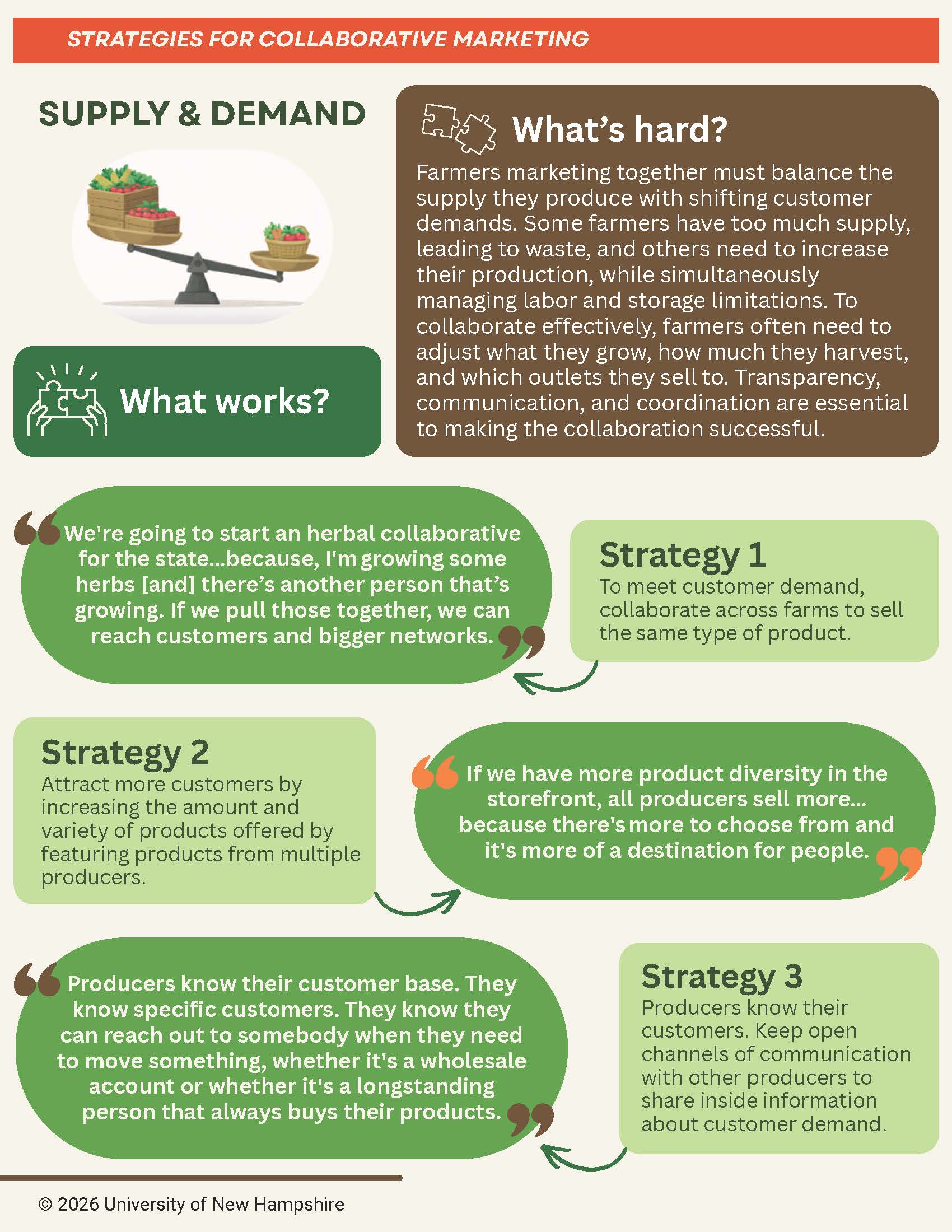
The first brief, Collaborative Aggregation & Marketing of Local Farm Food: A Qualitative Analysis of Farmers’ Collaboration Strategies, focuses on how farms collaborate with each other: coordinating supply and demand, planning crops, balancing specialization with diversity, and adapting to seasonality. The second brief, Collaborative Aggregation & Marketing of Local Farm Food: A Qualitative Analysis of Customer Relations Strategies, looks at the customer side: pricing, communicating quality, building relationships, improving convenience, and thinking about equity.
Together, the briefs show that collaborative marketing is not simply about pooling products. It is about coordination, shared decision-making, logistics, and customer experience. For farmers considering a collaborative marketing model, the briefs offer a practical place to dig deeper.
Wright says farmers shouldn’t be intimidated by the long titles: “The briefs are designed to be, well, brief! Rather than a 40-page report to sift through, we’ve created digestible summaries with clear headings to guide you to sections of interest. Check them out and see what resonates with you.”
For farmers, the lessons are practical: who grows what, how much variety to offer, how to avoid oversaturation, how to respond to seasonal realities, and how to make a collaborative model work for both growers and consumers. The project’s findings suggest that these models can create more stable markets, reduce some barriers for beginning farmers, support specialization, strengthen farmer networks, and broaden market access. But those benefits depend on strong governance, clear communication, and effective collaboration.
The team also hired the Food Works Group to assess the financial performance of the four case study models. The analysis looked at gross and net revenue, changes in sales over time, and how adding products, farmers, and sales channels affected the business. This assessment helped to identify each model’s key financial strengths and challenges, how governance structure impacts economic viability, and which adjustments or investments might offer the best return.
What’s next?
Looking ahead, Bruce will be synthesizing the interview and financial data to understand how external constraints shape the capacity of collaborations to create economically viable supply chains. Wright and Bruce are also exploring how best to share the project’s financial assessment and help farmers use tools to assess whether new collaborative ventures are financially viable. They are planning a training for agricultural service providers to expand the technical assistance available to farmers considering these kinds of collaborative efforts. To stay up to date on this and other Extension events, sign up for the UNH Extension Food & Ag Newsletter.
Extension Services & Tools That Help NH Farmers Grow

Newsletters: Choose from our many newsletters for production agriculture
Receive Pest Text Alerts - Text UNHIPM to (866) 645-7010
Author(s)


