Driving Innovation in Livestock and Dairy: Lessons from Value-Added Producers

Learn more about the Dairy & Livestock Value-Added Program
Driving Innovation in Livestock and Dairy: Lessons from Value-Added Producers
On December 3rd, the Livestock Value-Added Cohort traveled to Lilac Hedge Farm in Rutland, Massachusetts as a part of our ongoing grant work to support and develop cohorts of livestock and dairy value-added producers.
Lilac Hedge Farm has grown immensely over the past few years. What began as a small operation selling solely at farmers markets has expanded into a diversified, multi-channel business. Today, the farm sells through its on-site farmstand, numerous farmers markets, offers online ordering with home delivery, and even ships products throughout the Northeast as far as Indiana and North Carolina. They also run a monthly subscription service, providing customers with convenient, curated boxes of farm-raised goods. The farm raises beef cattle, hogs, sheep, and poultry, as well as partners with local farms to provide other products to its customers.
During our visit, we toured the farm’s retail area, which now includes an ice cream stand, farm stay rentals, a farm bar, and a full farm kitchen. This expansion shows how Lilac Hedge Farm continues to innovate and add value to its products and customer experience.
We then traveled to the farm’s packaging facility, where we were able to see behind the scenes of their processing and distribution operations. As we were there, the team was working to pack boxes to be delivered to homes the next day. The tour provided valuable insight into the systems and infrastructure needed to support home delivery and delivery throughout the East Coast.
And of course, no trip to Lilac Hedge Farm would be complete without stopping to say hello to the donkeys on our way out.

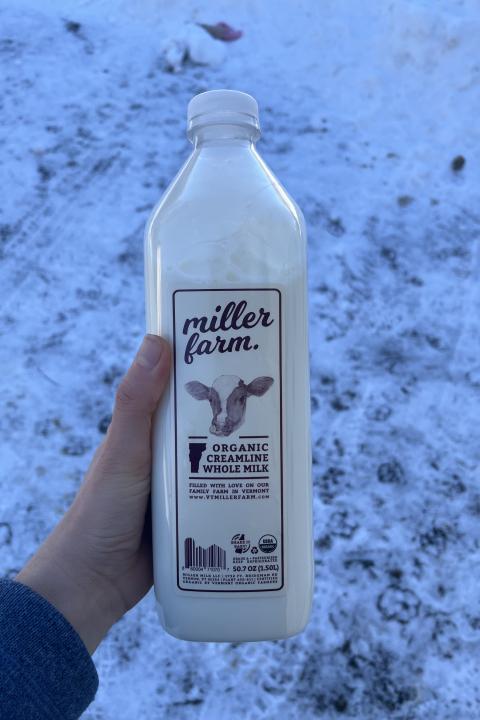
On December 17th, the Dairy Value-Added Cohort visited Miller Farm in Vernon, Vermont. Miller Farm is an organic dairy that produces and bottles creamline milk. Their milk is vat pasteurized and non-homogenized, allowing the cream to naturally rise to the top. Miller Farm milk is easy to distinguish in the store in clear PET plastic bottles with the creamline and instructions to “shake it baby!”. The farm also sells excess milk to Stonyfield.
The farm began bottling milk in 2020 after purchasing a processing facility, which is housed inside two shipping containers. This setup allows Miller Farm to process milk on-site in a relatively small footprint, and it was helpful for cohort members to see how a compact, modular facility can function effectively for value-added dairy production.
Miller Farm distributes its milk through regional distributors, reaching customers throughout Vermont and into other states across the Northeast. This approach has allowed the farm to expand beyond direct sales while still maintaining consistency in production and quality.
In addition to retail distribution, Miller Farm also supplies milk to local schools. For school programs, milk is processed into five-gallon bags and placed into a “silver cow” dispenser, which allows students to fill their own cups at lunchtime. This system reduces single-use packaging and food waste in local schools.
The visit provided a useful look at how an on-farm processing operation can grow, adapt, and serve multiple markets, and offered practical takeaways for cohort participants interested in value-added dairy opportunities.
We want to thank Lilac Hedge Farm and Miller Farm for hosting our groups. And the Northeast Extension Risk Management Education Center for providing funding for us to travel and visit other producers.
We look forward to our next visits in the New Year!
This material is based upon work supported by USDA/NIFA under Award Number 2024-70027-42540.


Extension Services & Tools That Help NH Farmers Grow

Newsletters: Choose from our many newsletters for production agriculture
Receive Pest Text Alerts - Text UNHIPM to (866) 645-7010

