From Plans to Progress
-
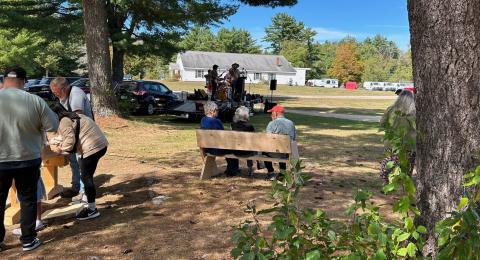
Wooden bench seating constructed and put to immediate use on the Common on Barrington Town Center Day.

Since the Town of Barrington and UNH Cooperative Extension completed the Downtowns & Trails program last fall, the community has shifted from assessment to active implementation. This progression reflects the core goal of the program: supporting long-term, place-based initiatives that build local capacity to turn data-driven recommendations into community-driven action. Just six months after the formal program ended, Barrington is already seeing results.
From Bench-Building to Trail Programming
Barrington’s Town Center Day in September marked an early milestone, weaving together several community initiatives including UNH Extension’s Downtowns and Trails program. A morning presentation of formal findings gave way to an interactive afternoon on the Common, creating space for residents to engage directly with the planning process and weigh in on preliminary recommendations. In a standout moment of implementation, volunteer A.J. Dupere built and installed a Leopold bench live during the event, helping address a frequently noted lack of seating with immediate community action.
This momentum is extending to the local business community as well; the July opening of Jackie’s Restaurant and Tavern adds a much-needed sit-down destination for breakfast and lunch, further establishing the town center area as a place for residents and visitors to gather and enjoy local amenities.
Complementing these efforts, the Barrington Parks & Recreation Department is conducting an asset analysis to inform the expansion of outdoor programming. Highlights include a new winter snowshoeing program on the Perimeter Trail and increased collaboration with recreation partners. By moving beyond self-guided use, the department aims to connect people more meaningfully with Barrington's natural assets. This shift treats outdoor spaces as vital "third spaces," unlocking their capacity for community building in a rural context.
Capacity Building: The Sign Committee
One of the report’s most visible recommendations was the need for improved wayfinding. To drive action, the town formed a dedicated Sign Committee with a mix of historical experts, artists, and task-oriented volunteers.
This committee-led approach is a model for leveraging volunteer expertise to accomplish specialized goals. Already, the group has developed a style guide to reinforce Barrington’s unique identity and is selecting a partner to create a comprehensive signage system, ranging from town-line and gateway markers to directional signs along Routes 9 and 125.
Supporting Data-Informed Decisions
The Downtowns & Trails report has also become a powerful tool for town leadership. Town Administrator Conner MacIver is utilizing the report's spatial data and community feedback to advocate for Barrington’s needs with the New Hampshire Department of Transportation (NHDOT). By presenting a data-backed case for pedestrian safety and traffic calming, Barrington is demonstrating to state partners that they have a clear, community-supported plan — a level of preparation essential for prioritizing infrastructure improvements on busy corridors.
The Power of Readiness
Barrington’s rapid progress highlights a critical factor in community development: Readiness. Over the last six months, the town has transitioned from planning to action by leveraging technical tools from partners like UNH Extension, Resilience Planning, and RKG Associates. However, those tools only worked because Barrington provided the necessary foundation: an organized leadership structure, a deep bench of committed volunteers, and a focused plan of action.
Barrington’s journey is about more than just trails; it’s about strengthening the connections between the people, the place, and the local economy.
Author(s)


